New ‘Retinol-Tan Clash’ Rule: The 2026 Derm Warning About Mixing Actives With Your Self-Tan
You are not being dramatic if your self tan looks great one day, then turns patchy the minute you bring retinol or exfoliating acids back into the picture. This is a very real routine clash. Self tanner needs a calm, fairly even skin surface to develop nicely. Retinoids and acids speed up cell turnover, can dry the skin, and can leave you with flaky spots that grab or shed color unevenly. Then vitamin C gets blamed too, even when the bigger issue is often overdoing too many strong steps at once. The good news is that the new 2026 derm advice is not “pick one or the other.” It is more about spacing, barrier care, and not stacking every active around your tanning night. If you have been asking can you use retinol and acids with self tanner, the answer is yes, but not all on the same night, and not without a simple plan.
⚡ In a Hurry? Key Takeaways
- You can use retinol and acids with self tanner, but space them out. Do not use retinoids or strong exfoliating acids on the same night you apply self tanner.
- For the best color, pause retinol and leave-on acids 24 hours before and after tanning, then restart slowly once the tan has settled.
- If your skin stings, feels tight, or the tan goes patchy fast, treat that as a barrier warning and cut back actives before adding more color.
Why this clash happens
Self tanner, usually powered by DHA, works on the top layer of skin. It develops best when that layer is smooth, hydrated, and not getting stripped too quickly.
Retinol, tretinoin, glycolic acid, lactic acid, salicylic acid, and peel pads all increase turnover or exfoliation in some way. That can be great for acne, texture, and fine lines. It can also make your tan fade faster, fade unevenly, or settle into dry patches.
So the 2026 warning is less “these ingredients are forbidden” and more “stop treating tanning night like any other skincare night.”
Can you use retinol and acids with self tanner?
Yes. Just not carelessly.
If you use self tanner and anti-aging or acne actives together, think of them like gym days and recovery days. Both can stay in your life. They just should not compete for the same time slot.
What to avoid on tanning day
Skip these on the face and body areas where you are tanning:
- Retinol and prescription retinoids
- Glycolic, lactic, mandelic, and salicylic acid leave-on products
- Strong exfoliating pads, scrubs, or peels
- Benzoyl peroxide if it tends to dry or irritate your skin
These steps can leave the skin too reactive or too uneven for a clean tan result.
What is usually fine
- Gentle cleanser
- Simple hydrating serum
- Barrier-supporting moisturizer
- Vitamin C in the morning, if your skin already tolerates it well and it is not paired with irritating acids
- Sunscreen during the day, always
Vitamin C is not automatically the villain here. For many people it is fine, especially in the morning and not layered with a bunch of other strong products. The real trouble usually comes from over-exfoliation.
The simplest rule to remember
Pause retinol and leave-on acids 24 hours before self tan, and 24 hours after.
If your skin is sensitive, dry, or you use prescription-strength retinoids, stretch that to 48 hours on either side. That gives your barrier time to settle and gives your tan time to develop and lock in more evenly.
If you want a deeper dive into the logic behind this, New ‘Retinol + Tan’ Rule: How To Layer Anti‑Aging Actives With Self Tanner Without Trashing Your Skin Barrier lays out why timing matters so much.
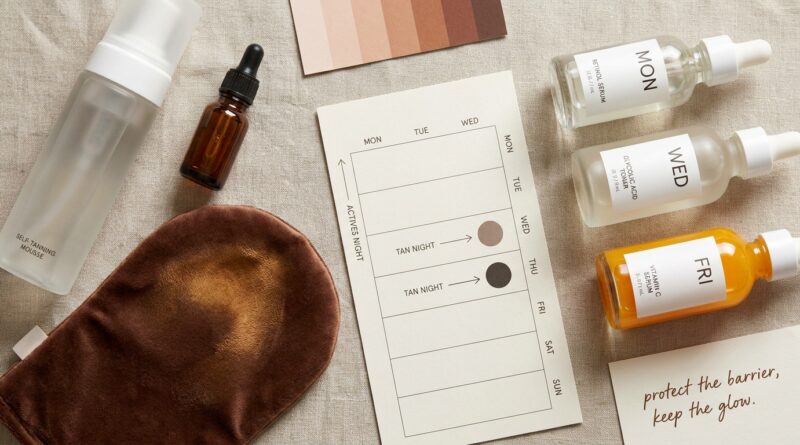
A dermatologist-informed weekly plan that actually works
Here is a realistic routine for someone who wants both active skincare and a nice self tan.
Option 1: Weekly self tan on Friday night
Wednesday night: Retinol night, if your skin tolerates it well.
Thursday morning: Gentle cleanse, vitamin C if you use it, moisturizer, SPF.
Thursday night: No retinol, no acids. Focus on hydration.
Friday morning: Keep it gentle. No acid toners or peel pads.
Friday night: Apply self tanner to clean, dry, moisturized-only-where-needed skin.
Saturday: Let the tan develop. Use bland, hydrating skincare only.
Sunday night: If skin feels normal, you can restart a gentle active. If you feel dry or tight, wait another day.
Option 2: If you use retinol 3 to 5 nights a week
This is where people usually run into trouble. If your retinol use is frequent, make tanning night your forced recovery night. Also make the night before a recovery night.
That means at least two low-drama nights in a row. Cleanser, moisturizer, maybe a hydrating serum. Nothing spicy.
Option 3: If you exfoliate for ingrowns or body acne
Body skin can be tougher, but it is still easy to overdo. Use your acid body lotion or pads a day or two before tanning, not on the same day. Then moisturize well so the skin is smooth, not raw.
How to handle different actives
Retinol and retinoids
These are the biggest fade-fast culprits because they can increase turnover and dryness. If your tan always disappears around the mouth, chin, chest, or hands, retinoids may be part of the reason.
Best move: use them on non-tanning nights only. Reduce frequency if your tan keeps going patchy.
AHAs like glycolic and lactic acid
Great for smoothing. Not great right before or right after self tanner. They can create a more even base if used early enough, but too close to tanning they can cause uneven development or rapid shedding.
Best move: use 24 to 48 hours before tanning, then stop.
BHA like salicylic acid
Useful for oily or acne-prone skin, but it can still dry some people out, especially combined with retinoids.
Best move: keep it away from tanning night and watch for hidden dryness.
Vitamin C
This one is usually more manageable. If your vitamin C serum is gentle and you use it in the morning, many people can continue it. If it stings, pills, or comes in a very strong low-pH formula, simplify around tanning days.
What patchy fading is really telling you
Patchy tan is often your skin sending a message before irritation becomes obvious.
Common clues:
- Color clings around the nose, brows, hands, elbows, or ankles
- The tan disappears faster around the mouth or chin
- Your skin feels squeaky, tight, or itchy after cleansing
- Moisturizer suddenly stings
That usually means your barrier needs a break more than your tan needs another layer.
How to protect your barrier and your glow
You do not need a 12-step routine. You need a boring one at the right time.
On the day before and day after tanning, keep it simple
- Use a gentle cleanser
- Use a plain moisturizer with ceramides, glycerin, or hyaluronic acid
- Avoid scrubs and hot showers
- Do not stack retinol, acid, and vitamin C all in one go
Moisturize strategically
Dry zones need a tiny bit of moisturizer before self tanner so they do not grab too much color. Think elbows, knees, ankles, knuckles, and around the nostrils or corners of the mouth if you tan your face.
Do not chase flakes with more exfoliation
This is the trap. If a fading tan starts to look rough, people often scrub harder or add acid. That usually makes the next tan even less even. Better to hydrate, let it fade naturally, then prep properly before the next application.
Special cases to keep in mind
Sensitive skin or eczema-prone skin
Be extra careful. If your barrier is already reactive, even a “gentle” self tanner plus regular retinol can be too much. Patch test, space things out more, and choose fragrance-free formulas where possible.
Acne treatment routines
If you are using prescription retinoids, benzoyl peroxide, or acid washes, ask your dermatologist how aggressive your routine really is. Sometimes one small timing change makes a huge difference.
Pregnancy and extra caution
Pregnant users often rework both skincare and tanning habits at the same time. That is another reason simple timing rules help. If you are pregnant or trying to conceive, double-check your retinoid use with your clinician first, since that issue matters more than the tan.
Signs you need to stop and reset
Take a week off actives and self tanner if you notice:
- Burning or ongoing stinging
- Visible peeling
- Redness that lasts more than a day
- Cracked or rashy skin
- A tan that develops strangely over irritated areas
At that point, your skin is asking for repair, not optimization.
At a Glance: Comparison
| Feature/Aspect | Details | Verdict |
|---|---|---|
| Retinol with self tanner | Can speed fading and increase dryness if used too close to tanning night | Use on separate nights. Pause 24 to 48 hours around tan application |
| Exfoliating acids with self tanner | Helpful for prep when used early enough, but can cause patchiness if used same day | Fine before tanning if spaced out. Avoid on tanning day and the day after |
| Vitamin C with self tanner | Usually less of a problem unless your formula is irritating or combined with too many other actives | Often okay in the morning. Stop if it stings or adds to irritation |
Conclusion
You do not have to choose between smart skincare and a believable glow. Right now a lot of glow lovers are upgrading their routines with serious actives at the same time that sunless tanning is getting more popular. Fresh 2026 guides on DHA safety and pregnancy, barrier care, and dose limits are useful, but the missing piece is the everyday routine plan. That plan is simple. Do not pile retinol, acids, and self tanner into the same window. Give your skin a buffer before and after tanning. Keep your barrier happy. Then restart actives slowly. Once you follow a weekly rhythm instead of guessing, the whole process gets much less stressful. Your tan looks better, your skin feels better, and you are far less likely to give up and drift back toward UV tanning just because your routine got messy.