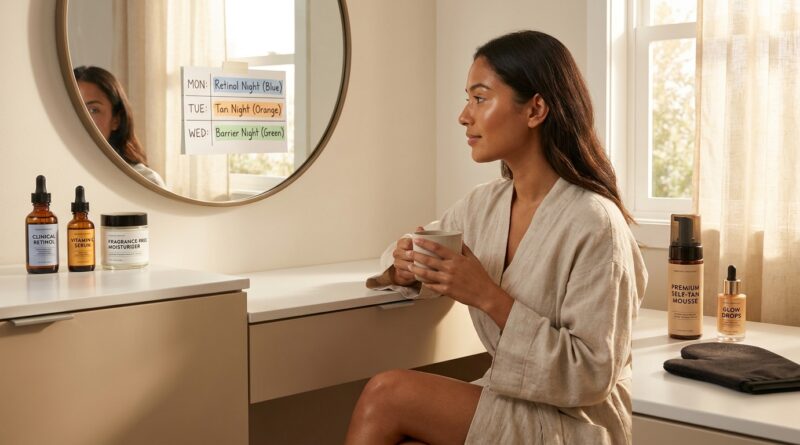
New ‘Retinol + Tan’ Rule: How To Layer Anti‑Aging Actives With Self Tanner Without Trashing Your Skin Barrier
You are not imagining it. The minute you finally get serious about retinol, vitamin C, and exfoliating acids, your self tan starts acting weird. Your cheeks sting. Your wrists go dark and patchy. Your glow fades fast, sometimes in 48 hours. It is frustrating because both goals make sense. You want smoother skin and a believable tan without baking in the sun. The trouble is that these products do not always play nicely together.
If you want the short answer to how to use retinol with self tanner safely, here it is. Do not stack everything on the same night. Give your skin a little breathing room. Use exfoliating acids before tanning, not right after. Pause retinol around your tan night if your skin is easily irritated. Then focus on moisture and barrier support so the color develops evenly and hangs on longer. Think timing, not just product choice.
⚡ In a Hurry? Key Takeaways
- Use retinol and self tanner on separate nights when possible, especially if your skin is sensitive.
- Exfoliate 24 hours before tanning, then switch to gentle cleansing and plenty of moisturizer.
- If your skin burns, flakes, or gets shiny-tight, stop actives first and fix your barrier before tanning again.
Why retinol and self tanner can clash
Retinol speeds up skin cell turnover. That is part of why it helps with fine lines, texture, and breakouts. Self tanner, usually made with DHA, works by reacting with the outermost layer of dead skin cells.
So here is the catch. If retinol and strong acids are pushing that top layer to shed faster, your tan has less to grab onto. The result can be uneven color, faster fading, and irritated skin.
That does not mean you have to choose one or the other. It just means you need a schedule.
The new “Retinol + Tan” rule
The simplest rule is this. Prep first, tan second, actives later.
In real life, that means:
Before tanning
Use exfoliating acids or a gentle body scrub 12 to 24 hours before your self tan. This clears off rough patches without leaving your skin freshly irritated at application time.
On tanning day
Skip retinol and strong acids. Keep skin clean, dry, and lightly moisturized only where needed, like elbows, knees, ankles, and wrists.
After tanning
Let the tan fully develop first. Then bring actives back slowly. If you use retinol on your face, consider waiting until the next night, or even 48 hours if your skin is easily upset.
How to use retinol with self tanner safely, step by step
1. Exfoliate early, not right before
A lot of patchiness starts here. People scrub hard, shave, use glycolic acid, then slap on self tanner a few hours later. That is a perfect setup for stinging and blotchy color.
Try this instead:
- Use your exfoliating acid or scrub the day before tanning.
- Shave or wax at least 24 hours ahead if your skin gets reactive.
- Skip any “peel pads” on tanning day.
If you are trying a new formula, do not guess. Do a quick safety check first with New ‘Invisible Patch Test’ Rule: The 5‑Minute Safety Check Every Self‑Tanner Should Do Before A Full‑Body Glow. It is a smart move, especially if you already use strong actives.
2. Pause retinol on tan night
This is the part most people resist. If retinol is your holy grail, skipping one night can feel wrong. But one night off is not going to erase your progress. It may save your skin barrier and your tan.
If your skin is resilient, you may be able to use retinol the night before tanning. If your skin is sensitive, red, or already peeling, stop retinol for one to two nights before and after your tan.
3. Keep vitamin C simple
Vitamin C is not automatically a problem, but it depends on the formula. A gentle serum in the morning may be fine. A strong, acidic version on irritated skin may not be.
If your routine already includes retinol and acids, do not pile on a stinging vitamin C serum around tanning day just because the internet says you need “the glow stack.” Calm skin usually tans better than overworked skin.
4. Moisturize like it actually matters
Barrier creams are not just for damage control. They help your tan look more even and last longer.
Use a plain, fragrance-free moisturizer after your tan has developed. Focus on dry zones. If your skin feels tight or itchy, that is a sign to back off the actives and add more barrier support.
Look for moisturizers with ceramides, glycerin, squalane, or hyaluronic acid. You do not need fancy. You need boring and reliable.
What about face tanning drops?
Face tanning drops are where things get tricky, because many people already use retinol, exfoliating acids, niacinamide, peptide serums, and sunscreen on their face every single day.
The safest method is to use face tan on a night when you are not using retinol or acids. Mix the drops with a basic moisturizer if the brand allows it. Then let your skin rest.
If your face flakes from tretinoin or retinal, expect the tan to fade faster there. That is normal. It does not mean you need more DHA. It usually means you need more moisture and fewer overlapping actives.
Signs your skin barrier is getting wrecked
This matters more than the tan.
Watch for these warning signs:
- Burning when you apply products that normally feel fine
- Shiny, tight, almost waxy-looking skin
- Flaking around the nose, mouth, or chin
- Redness that hangs around
- Tan grabbing in weird spots
If this sounds familiar, stop exfoliating acids and pause retinol for a few days. Use a gentle cleanser, a simple moisturizer, and sunscreen. Let your skin calm down before you try tanning again.
A simple weekly routine that works
Option for most people
- Day 1: Exfoliate gently. Moisturize.
- Day 2: Self tan at night. No retinol or acids.
- Day 3: Moisturizer only, or gentle vitamin C in the morning if your skin tolerates it.
- Day 4: Resume retinol if skin feels normal.
Option for sensitive skin
- Day 1: Light exfoliation only.
- Day 2: Moisturize and rest skin.
- Day 3: Self tan. No actives.
- Day 4: Moisturize only.
- Day 5: Restart retinol slowly.
Common mistakes that cause patchiness fast
These are the usual culprits:
- Using glycolic or salicylic acid right after tanning
- Applying retinol on dry, freshly tanned skin
- Skipping moisturizer because you think it will make the tan fade
- Layering too many strong products in the same 24-hour window
- Trying to “fix” uneven tan by adding more self tanner over irritated skin
If your tan always disappears quickly, your routine may be too aggressive, not too weak.
At a Glance: Comparison
| Feature/Aspect | Details | Verdict |
|---|---|---|
| Retinol timing | Best used on a different night from self tanner, especially for sensitive skin | Safer and usually gives a more even, longer-lasting tan |
| Exfoliating acids | Use 12 to 24 hours before tanning, not right after | Good for prep, bad for fresh tan maintenance |
| Barrier creams and moisturizer | Help reduce irritation, dryness, and patchy fade | Essential, not optional |
Conclusion
You do not need to quit retinol to keep a nice fake tan, and you do not need to give up self tanner just because your skincare routine got more serious. You just need better spacing. Right now more people than ever are using strong actives while choosing sunless tanning as the safer alternative to UV, and that combo can work really well. But it is unforgiving when you rush it. Too much exfoliation plus DHA can lead to irritation, rebound sensitivity, and a tan that fades in weird patches right when you want to look your best. A simple, safety-first plan for timing retinoids, vitamin C, exfoliating acids, and barrier creams will protect your skin, help your color last, and cut through a lot of noisy TikTok advice. Calm skin almost always looks better. That is the real glow-up.