New ‘Pregnancy-Safe Tan’ Rule: What The 2026 DHA Safety Update Really Means For Your Sunless Glow
If you are pregnant or trying to conceive, the self-tanner panic online can get intense fast. One video says DHA is harmless. The next says your mousse is basically a chemistry experiment that somehow reaches the baby. No wonder people are stuck. The good news is that a major pregnancy exposure center quietly updated its 2026 guidance, and it is a lot more specific than the recycled beauty advice still floating around. The short version is reassuring. Standard self tanner used on intact skin, like lotions, creams, and mousses, appears to lead to very low absorption into the bloodstream. That is different from spray booths or face mists that can be inhaled or get into your mouth, nose, or eyes. So if your question is “is self tanner safe during pregnancy 2026,” the answer is usually yes for topical use on healthy skin, with a few smart limits that are worth knowing before your next glow-up.
⚡ In a Hurry? Key Takeaways
- For most pregnant and TTC people, self tanner lotions and mousses used on intact skin are generally considered low risk in 2026 guidance.
- Skip or be extra cautious with spray tans, aerosol mists, and products that can be inhaled or reach mucous membranes like the nose, mouth, and eyes.
- The main safety difference is not “DHA yes or no.” It is how the product is applied, where it lands, and whether your skin barrier is healthy.
What changed in the 2026 DHA safety update?
The biggest change is not that experts suddenly declared every tanning product perfect. It is that the guidance got more precise.
Older coverage often lumped all sunless tanning into one scary bucket. The 2026 update draws a cleaner line between DHA sitting on the outer layer of intact skin and DHA being inhaled, swallowed, or pushed onto broken skin or mucous membranes.
That matters because DHA works mostly at the skin surface. It reacts with dead skin cells in the top layer to create the color change. The updated guidance notes that when DHA is applied to intact skin in a lotion, cream, or mousse, systemic absorption appears to be very low. In plain English, not much gets past the outer barrier and into the bloodstream.
That is a very different exposure story from standing in a spray booth breathing in a fine mist.
So, is self tanner safe during pregnancy 2026?
For most people, a topical self tanner is the lower-risk way to get color during pregnancy compared with UV tanning or sunbathing.
If you want the practical answer, here it is.
Usually considered the safer choice
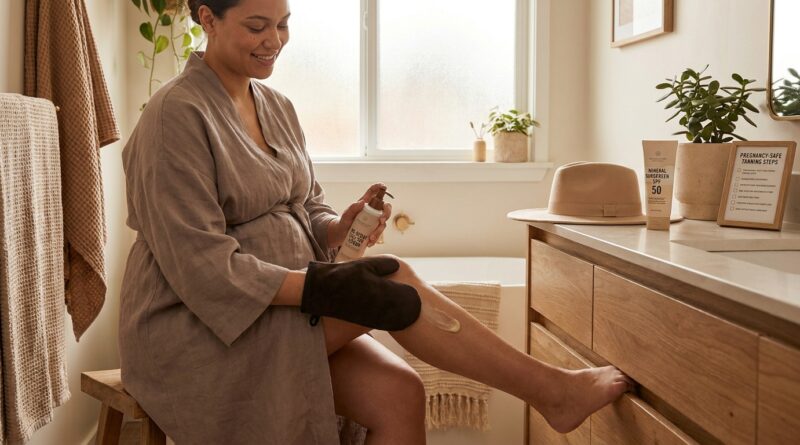
Lotions, creams, gels, drops mixed into body moisturizer, and mousses applied by hand or mitt on healthy, unbroken skin are generally the most pregnancy-friendly options.
Use more caution with these
Spray tans, aerosol self tanners, face mists, and any product likely to be inhaled or get into your nose, mouth, or eyes deserve more caution. The concern is less about the bronze look on your legs and more about unintended internal exposure through breathing or swallowing droplets.
Maybe wait or ask your OB first if this sounds like you
If you have asthma, bad nausea with strong product smells, eczema flares, broken skin, recent shaving irritation, active rashes, or you are using multiple treatment products on the same area, it is worth checking first.
Why lotions and mousses are different from spray booths
This is the part TikTok usually skips.
When you smooth a mousse onto your arms and legs, the product mostly stays where you put it. You can wash your hands after, avoid the nipple area if breastfeeding later on, and keep it away from your lips and nostrils.
In a spray booth, even a good one, there is a decent chance you inhale some mist. Tiny particles can also settle on your lips, inside your nose, or around the eyes. Those tissues are much better at absorbing substances than the outer dead layer of skin.
That is why many pregnancy experts sound fairly comfortable about self tanner on intact skin but still wave a yellow caution flag at booth spraying.
What the new absorption numbers really mean
Here is the non-scary translation. The updated guidance reflects that DHA absorption through intact skin appears minimal, with most of the color reaction happening in the stratum corneum, which is the outermost dead-skin layer. It does not mean zero exposure under every condition. It means the amount getting into circulation from normal topical use appears very small.
That is enough for many OBs and midwives to say a cream or mousse is reasonable if it helps you avoid UV tanning.
It is also why application details matter so much. Healthy skin barrier, no inhalation, no use on irritated areas. Those little choices make the risk profile look very different.
Where pregnant readers should be more careful
Broken or irritated skin
If you just shaved, waxed, scrubbed, or have cracked, inflamed, or peeling skin, wait. Skin barrier damage can change absorption and usually makes the tan look worse anyway.
Mucous membranes
Avoid getting product in or near your nose, mouth, eyes, or genital area. This is especially important with face sprays and contour mists.
Inhalation risk
If the product becomes airborne, your risk question changes. A booth spray or aerosol can create a type of exposure that lotions do not.
Extra actives on the skin
If your skin routine includes retinoids, exfoliating acids, benzoyl peroxide, or strong acne products, you may also be dealing with irritation and patchiness. That is one reason New ‘Retinol-Tan Clash’ Rule: The 2026 Derm Warning About Mixing Actives With Your Self-Tan is worth a read. It is not just about how your tan looks. It can also help you spot when your skin barrier is too cranky for self tanner that day.
A screenshot checklist to take to your OB or midwife
If you want a simple, sensible plan, use this.
- Choose lotion, cream, or mousse over spray booth or aerosol.
- Apply only to intact, healthy skin.
- Do not use right after shaving, waxing, scrubbing, or a peel.
- Avoid the nose, mouth, eyes, nipples, and genital area.
- Use in a well-ventilated room.
- Wash hands well after applying.
- Skip products with a strong fragrance if smells trigger nausea.
- Patch test first if your skin has been more reactive during pregnancy.
- Ask your OB or midwife if you have asthma, eczema, open skin, or a high-risk pregnancy with very strict exposure guidance.
Best practices if you still want a glow
Pick the boring format
This is one of those rare times when boring is good. A basic mousse or lotion is easier to control than a mist. Less overspray. Less inhalation. Less drama.
Use a mitt
A mitt keeps your palms from staining and reduces the chance of spreading product to your face by accident.
Keep it below the jaw if you are worried
If face application makes you nervous, skip it. A body glow can still do a lot, and bronzing makeup can handle the rest.
Ventilate the room
Open a window or turn on a fan, especially if the smell turns your stomach.
Do not confuse self tanner with sunscreen
A fake tan does not protect your skin from UV damage. You still need sun protection.
Questions people are afraid to ask
What if I used self tanner before I knew I was pregnant?
Do not panic. If it was a standard topical self tanner on intact skin, that is generally not the kind of exposure that sends doctors into emergency mode. Bring it up at your next appointment for peace of mind, but this is usually a reassurance conversation, not a crisis one.
What about breastfeeding later?
Many experts give similar practical advice. Topical self tanner on intact skin is different from direct ingestion. Just avoid applying it where the baby could directly mouth the skin, especially the nipple and areola area.
Are “natural” self tanners safer?
Not automatically. “Natural” is a label, not a medical category. Look at the format and how you apply it, not just the front of the bottle.
At a Glance: Comparison
| Feature/Aspect | Details | Verdict |
|---|---|---|
| Topical lotion or mousse | Applied to intact skin, low expected absorption, easier to keep away from mouth and nose | Generally the preferred pregnancy option |
| Spray booth or aerosol mist | Higher chance of inhalation and contact with mucous membranes | More caution advised, often best to skip |
| Application on irritated or broken skin | Skin barrier is compromised, possible higher absorption and more irritation | Wait until skin heals first |
Conclusion
If you have been stuck between “totally safe” and “absolutely toxic,” the 2026 update offers a much calmer middle ground. A major pregnancy exposure center quietly clarified that DHA in self tanners behaves differently depending on how it is used. On intact skin in a lotion or mousse, the amount getting into your bloodstream appears very low. In a spray booth or mist you can inhale, it is a different story, which is why those methods deserve more caution. That is the part a lot of older beauty coverage misses. So yes, you can usually choose a UV-free glow during pregnancy without spiraling. Pick a controllable formula, keep it off mucous membranes, avoid broken skin, and bring the checklist above to your OB or midwife if you want a personalized green light. That is not being fussy. That is being smart in a season where everyone wants clear answers.