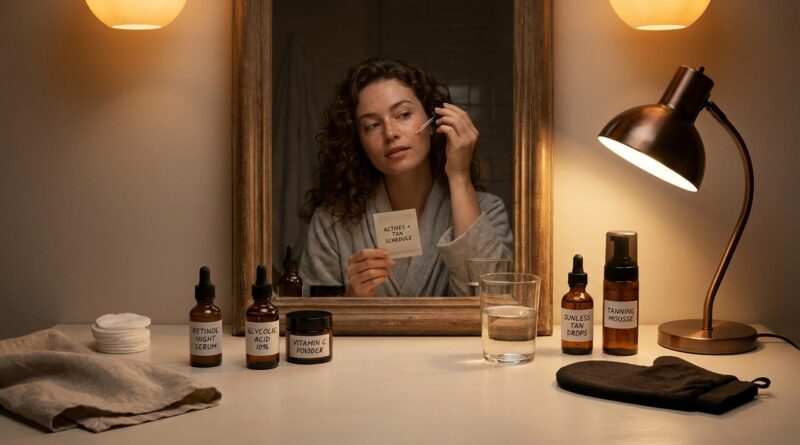
New ‘Actives-Friendly Tan’ Rule: How To Use Retinol, Acids And Self Tanner Together Without Trashing Your Skin
You get your skin looking calm, smooth and clear with retinol, acids and brightening serums, then self tanner enters the chat and everything goes sideways. Your face turns patchy. Dry flakes grab color. Or the tan looks great for one night and disappears after two washes. It is frustrating, and a lot of the advice online makes it worse because it treats skincare and self tanning like totally separate worlds. They are not. The short answer to “can you use retinol and self tanner together” is yes, but not at the same time, not on irritated skin, and not without changing your routine a bit. The goal is to protect your skin barrier first, then give DHA a smooth, calm surface to develop on. Once you do that, you can keep your actives and your glow without wrecking your face in the process.
⚡ In a Hurry? Key Takeaways
- Yes, you can use retinol and self tanner together, but separate them by at least 24 hours when possible and never layer them on irritated skin.
- Pause strong exfoliating acids and retinoids the night before and the night of facial self tanning for a more even, longer-lasting result.
- If your skin stings, burns, flakes or looks shiny-tight, fix your barrier first. Tanner on damaged skin usually means patchiness and more irritation.
Why this combo gets so tricky
Self tanner works on the top layer of skin. The active ingredient, usually DHA, reacts with dead skin cells to create that temporary bronzed color.
Retinol and exfoliating acids do the opposite of what your tan wants. They speed up cell turnover, loosen dead skin, and can leave your skin a little drier or more sensitive. That is great when you are trying to smooth texture or fade marks. It is not so great when you want color to grab evenly and stick around.
So if your facial tan fades fast, gets speckled around your nose, or clings to random dry spots, your actives may be the reason. Not because DHA is automatically unsafe, but because the skin surface is changing faster than the tan can hold on.
So, can you use retinol and self tanner together?
Yes. Just not in the “slap both on the same night and hope for the best” way.
The safest and most reliable rule is this: use your actives and your self tanner in the same weekly routine, but give them space. Think of it like washing a silk shirt and a muddy dog blanket. Both belong in your life. They just should not go in the machine together.
The simple answer
If you use retinol, tretinoin, adapalene, glycolic acid, lactic acid, salicylic acid, or strong vitamin C, your facial self tanner will usually look better if you pause the strongest stuff right before tanning.
For most people, that means:
- No retinol the night before self tanning
- No retinol the night you apply self tanner
- No strong exfoliating acids the day before or the day of tanning
- Keep the rest of the routine bland and moisturizing
What DHA actually does, and what it does not do
DHA does not tan living skin the way the sun does. It does not need UV light. It reacts with proteins in the outermost dead skin cells.
That matters because if your skin is over-exfoliated, flaky or inflamed, DHA may develop unevenly. It can also look darker in dry areas and vanish faster where your routine is peeling skin away more quickly.
DHA itself is not automatically harsh for everyone. The problem is often the condition of the skin underneath it. A calm, hydrated face can usually handle self tanner just fine. A face that is already annoyed by retinoids or acids often cannot.
The “Actives-Friendly Tan” rule
If you want your skincare and self tanning routine to stop fighting each other, follow this rule: Tan on a calm skin night, not an active skin night.
That means your best self tanning night is one where your skin has been gently cleansed, lightly moisturized if needed, and left alone long enough for DHA to develop evenly.
Best timing for most people
Here is an easy face-tanning schedule:
- Night before tanning: Skip retinol and strong acids. Cleanse, hydrate, moisturize.
- Tanning night: Cleanse. Let skin fully dry. Apply self tanner. Skip retinol, acids and most strong treatment serums.
- Next morning: Rinse if your product says to. Use a gentle moisturizer and sunscreen.
- 24 hours later: If your skin feels normal, you can slowly resume actives.
If your skin is very sensitive, stretch that gap longer. A 48-hour break on either side of tanning often gives a smoother result.
How to layer common actives without ruining your tan
Retinol and prescription retinoids
Retinol, retinal, tretinoin and adapalene can all make facial tan fade faster. They can also create dry patches that self tanner loves to exaggerate.
Best move: do not apply retinol right before self tanner. If your skin is adjusted and strong, you may be able to use retinol on off nights and tan once or twice a week. If you are new to retinoids, put the tan on hold until your skin stops peeling and stinging.
Glycolic, lactic and mandelic acids
These exfoliating acids can make skin smoother over time, but they also lift the very surface layer DHA colors. Translation: faster fade, more risk of patchiness.
Best move: avoid them the day before, day of, and sometimes the day after facial tanning if your skin runs dry.
Salicylic acid
Salicylic acid can be less obvious than glycolic, but it still affects how evenly your tan sits, especially around the nose and chin where people often use acne products.
Best move: if you use it as a spot treatment, keep it away from freshly tanned areas for a day. If it is in your cleanser, use a gentler cleanser around tanning time.
Vitamin C
Vitamin C is the wildcard. Some people use it with no issue. Others find it stings on tanning night or makes the tan look less even if the formula is very acidic.
Best move: if your vitamin C is gentle and your skin is happy, you may keep it in the morning. But if your face gets reactive, skip it on tanning day and the morning after.
When you should not self tan your face at all
Sometimes the right answer is not “use less.” It is “wait.”
Skip facial self tanner for now if:
- Your skin burns when you apply moisturizer
- You have visible peeling from retinoids
- Your skin looks red, shiny or tight
- You are having an eczema, perioral dermatitis or rosacea flare
- You just started a new prescription acne treatment
In those moments, the problem is not the tanner. It is your barrier asking for a break.
A safe, simple routine that actually works
Night 1: Recovery night
Use a gentle cleanser, hydrating serum if you like, and a plain moisturizer. No acids. No retinol. No scrubs.
Night 2: Self tan night
Wash your face with a non-stripping cleanser. Let skin dry fully. Apply a light layer of facial self tanner. Blend well around the hairline, nose and jaw. Leave it alone.
If you are using a mousse or product not designed for the face, be extra careful. Facial skin is usually more reactive than the body.
Night 3: Maintenance
Use gentle skincare only. Moisturizer is your friend here. Hydrated skin sheds more evenly and keeps the color looking smoother.
Night 4 and beyond
If your skin feels normal, slowly bring back your retinol or acids. Not both at once if you are sensitive.
How to make your facial tan last longer without stopping all skincare
You do not have to choose between glow and good skin. You just need to reduce the friction between the two routines.
- Use lower-strength actives more consistently instead of nuking your face once a week
- Moisturize dry zones before they turn flaky
- Avoid manual scrubs on the face
- Use a gradual tanning mist or drops for easier touch-ups
- Tan more lightly, more often, instead of one super dark application
A lighter tan usually fades more gracefully on active-treated skin.
Patch testing matters more than people think
If your skin is on retinoids, acne treatments or acids, patch testing is not just a nice extra. It is smart.
You are not only checking for an allergy. You are checking for irritation, weird color development, and whether the product grabs onto dry patches. If you want a better way to do that, read New ‘Allergy-Safe Glow’ Rule: How To Patch-Test Self Tanner Like Derms Do In 2026. It is a good safety step, especially if your skin routine is already strong.
Common mistakes that cause streaks, flakes and fast fade
1. Applying tan right after an acid peel
This is one of the fastest ways to get a weird result. Freshly exfoliated skin may look smooth at first, but it can become uneven as it dries out.
2. Using retinol on top of fresh self tanner
That usually means faster fade and possible blotching by morning.
3. Ignoring dry patches around the nose and mouth
Those spots often hold onto color harder than the rest of your face. A tiny bit of moisturizer before tanning can help buffer them.
4. Tanning over irritated skin
If it stings before the tan, it will probably look worse after.
What if you use prescription acne or anti-aging products?
Be more cautious, not more brave.
If you use tretinoin, tazarotene, benzoyl peroxide, azelaic acid, hydroquinone, or medicated exfoliants, your skin may already be in a high-turnover state. That does not mean you can never self tan. It does mean you should expect shorter wear time and you should avoid tanning through active irritation.
If you are under a dermatologist’s care and your skin has been reactive, ask before trying a new facial tanner. Especially if you are dealing with melasma, rosacea, acne treatment peeling or barrier damage.
At a Glance: Comparison
| Feature/Aspect | Details | Verdict |
|---|---|---|
| Retinol with self tanner | Can be used in the same weekly routine, but not ideally on the same night. Retinol speeds up fade and can cause patchy grab on dry skin. | Best to pause 24 hours around tanning. |
| Exfoliating acids with self tanner | AHAs and BHAs can make tan develop unevenly and disappear faster by removing the top layer DHA colors. | Use cautiously and avoid near tanning time. |
| Barrier health | If skin is calm, hydrated and not peeling, self tanner is much more likely to look even and feel comfortable. | Most important factor of all. |
Conclusion
Trying to juggle retinol, acids, vitamin C and regular self tanning can feel weirdly harder than it should. That is mostly because comment sections love one-size-fits-all advice, and your face is not one-size-fits-all. The good news is the fix is usually simple. Keep strong actives away from tanning night, do not tan over irritated skin, and treat barrier health like the main event. That one shift helps you avoid sensitivity, wasted product and those annoying two-day patchy fades. Once you understand how DHA behaves on exfoliated or medicated skin, the whole routine gets easier. You do not need to give up serious skincare to keep a sunless glow. You just need a smarter schedule.