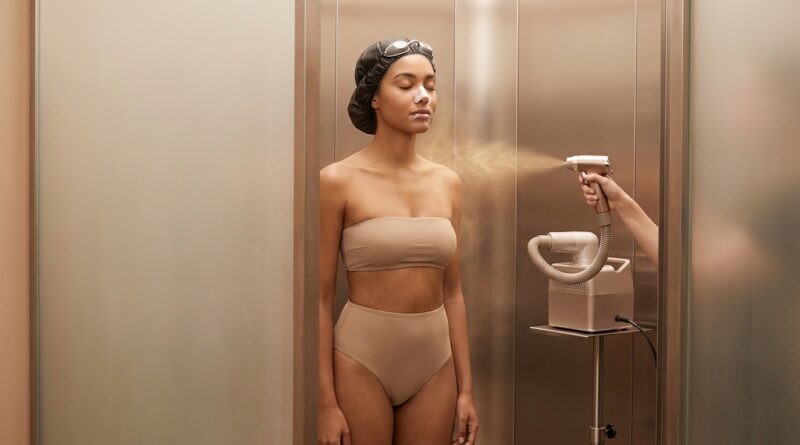
New ‘Spray-Tan Safe Zone’ Rule: How To Use Sunless Mists Without Breathing In The Bad Stuff
You are not being dramatic if the face mist part of a spray tan makes you pause. A lot of people hear “sunless” and assume that means risk-free, then stand there breathing normally while DHA drifts around their nose, mouth and eyes. That is the gap nobody explains well. The tanning solution is meant for the outer skin, not for your lungs or lips. So if you love the look of a spray tan but feel uneasy about inhaling DHA, that instinct is smart.
The good news is you do not need to panic or swear off booths forever. You just need a better routine. The basic rule is simple. Keep the mist on your skin, and out of your airway, eyes and mouth as much as possible. That means asking for protective gear, timing your breaths during facial passes, closing your lips, shielding your eyes and choosing salons that take ventilation seriously. Think of it like hair dye or nail dust. Useful on the body. Not something you want floating deep into your lungs.
⚡ In a Hurry? Key Takeaways
- Yes, spray tan safety inhaling DHA matters. DHA is intended for skin contact, not for breathing in through your nose or mouth.
- Use nose filters, eye protection and lip balm, then hold your breath briefly during face spraying if your salon offers a facial mist pass.
- A good salon should have ventilation, clear instructions and no weird pressure to skip protective steps for a “better result.”
What the new “safe zone” idea really means
The phrase sounds fancy, but the idea is plain English. Your safe zone is the space where spray tan solution belongs. That is your outer skin. The unsafe zone is where the mist can accidentally go if nobody is careful. Your lungs, eyes, inside your nose and lips.
DHA, short for dihydroxyacetone, is the ingredient that reacts with dead skin cells to create that bronzed look. That skin-surface reaction is the whole point. The concern starts when the same mist becomes airborne around your face. Regulators and skin experts have been talking more openly about this because people often assume “sunless” equals “totally harmless in every form.” Those are not the same thing.
It is also why the search term spray tan safety inhaling DHA keeps popping up. People are trying to sort out a very normal question. If the tan is going on my face, what am I supposed to do while it is floating in front of my face?
Why this matters more right now
Tanmaxxing trends, peptide chatter and so-called “Barbie tan” injections have made a lot of beauty routines feel more extreme than they need to be. For many people, the spray booth now looks like the sensible middle ground. And in many ways, it is. It avoids UV tanning. It skips the sketchy injection route. But “safer” does not mean “no precautions needed.”
That is the part the beauty world often skips. You get pages of advice on prep, exfoliation and what color undertone to choose. You get almost nothing on what to do with your breathing when the face mist starts.
The biggest mistake people make during a facial spray
They act like they are standing in a gentle rain. They keep talking, breathing through their mouth, blinking into the mist and hoping for the best.
That is not ideal. If the technician is spraying your face, you want a short, controlled pause in breathing during the pass. Not a dramatic underwater stunt. Just a brief hold while the cloud moves across your face, then resume breathing once it clears.
If you are in an automated booth, listen closely to the booth prompts before the face pass starts. If there are no clear prompts, ask the salon exactly when the facial spray happens.
How to protect your lungs, eyes and lips
1. Ask for nose filters or plugs
This is the most practical step, and a lot of people skip it because they feel awkward asking. Do not. Nose filters are there for a reason. They reduce how much airborne mist can get into your nasal passages during the spray.
If a salon acts confused when you ask, that is useful information. A place that takes inhalation concerns seriously should know what you mean.
2. Keep your mouth closed during the face pass
It sounds obvious, but it matters. Do not chat with the tech while your face is being sprayed. Press your lips together gently. A thin layer of lip balm can also help create a small barrier so the solution is less likely to sit directly on your lips.
3. Protect your eyes
Close your eyes fully during the face spray. Some salons also offer protective eyewear. If they do, use it. If they do not, ask how they reduce overspray around the eyes. You are not being difficult. You are asking a basic safety question.
4. Hold your breath briefly, then step back into normal breathing
The trick is timing, not toughness. You do not need to hold your breath for a long time. Just for the few seconds the facial mist crosses your face. If you are getting a manual spray tan, ask the tech to say “breath hold” right before the face pass and “okay” right after.
5. Wipe your lips and rinse your nostrils afterward if needed
If you feel residue on your lips, wipe it off gently once the session is over. If your nostrils feel coated, a gentle rinse later can help. Do not scrub your whole face right after a fresh tan, of course. Just clean the areas where the product clearly should not sit.
What to ask the salon before you book
A good salon will not be offended by these questions. In fact, the best ones answer them fast.
- Do you provide nose filters, eye protection or lip protection?
- How is the room or booth ventilated?
- Do you give instructions for breathing during the facial spray?
- Can I skip the face spray and use a separate self-tan face product later if I prefer?
- Do staff wear masks during repeated spray sessions?
If the answers are vague, rushed or dismissive, trust your gut. You are not buying a mystery glow. You are paying for a service that should be done with some care.
And while you are thinking about booth setup, floors and airflow, our guide to New ‘Spray-Booth-Safe’ Rule: How To Avoid Falls, Fumes And Blotchy Ankles In Modern Sunless Tanning Booths covers the other booth problems people forget until they are standing on a slippery floor wondering what just happened.
Manual spray tan vs booth. Which is easier to control?
Both can be done well. Both can be done badly.
Manual spray tan
The big upside is communication. A trained technician can warn you before they spray your face, lighten the pass, or skip it completely if you prefer to tan your face separately at home. The downside is that quality depends heavily on the person doing it.
Automated booth
The upside is consistency. The downside is that the machine does not read your expression if you are confused about when to hold your breath. If the booth instructions are poor or too fast, inhalation risk can feel more likely simply because you are guessing.
For many people, the safest route is the one where instructions are clearest and you feel comfortable speaking up.
If you want to be extra careful, skip the face mist
This is an underrated option. You do not have to spray your face just because the rest of your body is being sprayed. Plenty of people get a body spray tan, then use a cream, drops or mousse designed for the face later at home. That gives you more control and much less airborne exposure around the nose and mouth.
If you have asthma, allergies, a sensitive airway or just hate the feeling of aerosol around your face, this is probably the smartest move.
Who should be more cautious than average?
Some people have less room for trial and error.
- People with asthma or other breathing issues
- Anyone with very sensitive eyes
- People who feel faint or panicky in enclosed booths
- Anyone getting frequent spray tans and repeated face exposure
- Salon workers who are around the mist all day
If that sounds like you, talk to the salon ahead of time and keep the face area low-mist or skip it entirely. More glow is not worth feeling rough afterward.
What not to do
- Do not inhale normally during a direct face spray.
- Do not assume every salon automatically gives nose plugs or eye covers.
- Do not let anyone talk you out of protection because it might “mess up the tan.”
- Do not keep your lips parted during the pass.
- Do not confuse “sunless” with “fine to breathe.”
Does this mean spray tans are unsafe?
No. It means they should be used properly. That is a big difference.
For most people, the practical question is not “Should I fear spray tans?” It is “How do I avoid turning a skin treatment into an inhalation event?” Once you frame it that way, the steps get very simple. Use protection. Get clear instructions. Limit facial overspray. Skip the face if needed.
That is a lot more helpful than the usual internet extremes where one side says everything is toxic and the other side says concerns are silly.
At a Glance: Comparison
| Feature/Aspect | Details | Verdict |
|---|---|---|
| Face spraying with protection | Use nose filters, close eyes, seal lips and hold breath briefly during the pass | Best if you want a full-face tan and your salon gives clear instructions |
| Face spraying without protection | More chance of breathing in DHA mist or getting residue on lips and around eyes | Not recommended |
| Skipping face mist | Tan the body in the booth, then use a face self-tanner at home | Safest choice for people worried about spray tan safety inhaling DHA |
Conclusion
Spray tans can still be the sane option in a beauty cycle full of over-the-top trends, but only if we stop pretending the airborne part does not matter. That is why this matters for the I Love Tanning community right now. More people are being pushed toward booths as the “safe” alternative to peptide tan shots and extreme tanmaxxing, yet very few salons or beauty blogs explain the small habits that actually protect you. Keep the mist on skin, not in lungs. Ask for nose filters. Close your eyes and lips. Hold your breath briefly during facial passes, or skip the face mist altogether. That calm, step-by-step approach lets you enjoy the glow, avoid the sketchier stuff and make smart choices without getting scared out of a routine you otherwise love.