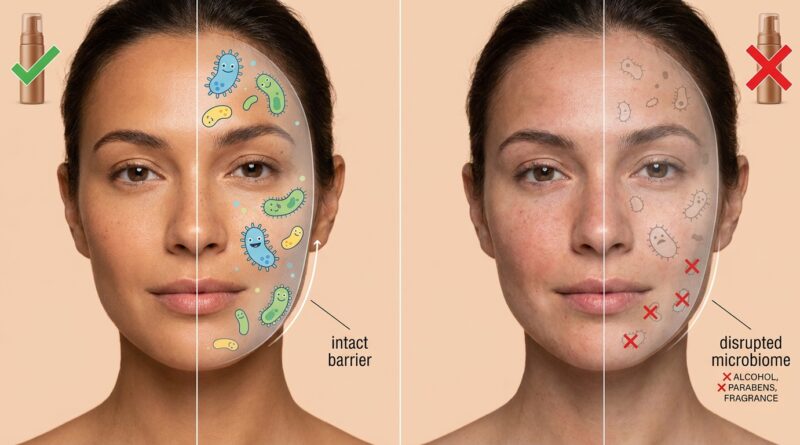
New ‘Microbiome-Safe Glow’ Rule: How To Pick Self‑Tanners That Don’t Wreck Your Skin’s Good Bacteria
You are not imagining it if your favorite self tanner suddenly makes your skin feel tight, stingy, rough, or weirdly breakout-prone. That “glow” can come with a hidden cost when you use the wrong formula too often. A lot of self-tanners rely on DHA, drying alcohols, heavy fragrance, and preservatives that can chip away at your skin barrier and throw off the microbiome, which is the community of good bacteria that helps keep skin calm, strong, and balanced. Once that balance gets disrupted, your tan may even start looking worse. Think patchy fade, uneven grab, redness, and random sensitivity to products that never used to bother you. The good news is you do not have to give up your bronze. You just need a smarter way to shop and a routine that gives your skin some breathing room. That is where the new microbiome safe self tanner rule comes in.
⚡ In a Hurry? Key Takeaways
- A microbiome safe self tanner usually avoids heavy fragrance and high amounts of drying alcohol, and pairs DHA with barrier-supporting ingredients like glycerin, squalane, ceramides, or panthenol.
- Use self-tanner less aggressively. Prep gently, skip harsh acids and scrubs around tan day, and give your skin recovery nights between applications.
- If your skin is suddenly itchy, blotchy, or breaking out, stop layering active products with your tan and focus on barrier repair first.
Why self-tanner can mess with your skin microbiome
Your skin is not just a surface. It is an ecosystem. The microbiome helps manage inflammation, keeps bad microbes in check, and supports the barrier that holds moisture in and irritants out.
Self-tanner itself is not automatically the villain. The trouble usually comes from the full formula and how often it is used. DHA, the tanning ingredient that reacts with the outer layer of skin, is often mixed with alcohol, fragrance, exfoliating acids, and strong preservatives. That combo can dry out the surface, shift skin pH, and stress the bacteria that help skin stay steady.
When that happens, you may notice more than “sensitivity.” You might see flaky patches, tiny bumps, more redness around the nose and mouth, or a tan that clings to rough spots and fades in blotches.
If this sounds familiar, New ‘Microbiome-Safe Tan’ Rule: How To Keep Your Fake Glow Without Wrecking Your Skin’s Good Bacteria is a helpful companion read. It explains why skin can start acting up even when a product used to seem fine.
What “microbiome safe self tanner” really means
This label is not a regulated medical standard, so brands can use it loosely. That means you need to read past the marketing.
A microbiome safe self tanner is usually one that tries to tan the skin without stripping it, over-perfuming it, or piling on ingredients that raise irritation risk with repeated use.
Good signs on the label
Look for formulas with simple ingredient lists and supportive hydrators. Helpful ingredients include:
- Glycerin
- Panthenol
- Squalane
- Ceramides
- Colloidal oatmeal
- Aloe, if your skin tolerates it
- Hyaluronic acid, mainly for comfort and hydration
These do not “feed” the microbiome in a magical way. What they do is support the barrier, which gives your skin’s natural bacteria a better environment to stay balanced.
Red flags to watch for
Be more careful with formulas that contain:
- Strong added fragrance or parfum high on the list
- Denatured alcohol near the top ingredients
- Essential oil blends if you are reactive
- AHAs, BHAs, or retinoid-style actives in the same product
- Lots of colorants or shimmer if your skin is already touchy
None of these are automatically bad for everyone. The issue is repeated exposure, especially if you tan weekly or top up every few days.
How to shop smarter without needing a chemistry degree
1. Start with the format
Mousses often dry faster, but many also rely on more alcohol for that quick-set feel. Lotions, creams, and serum-style tanners are often easier on dry or sensitive skin because they usually include more moisturizers.
If your skin is reactive, a gradual tanning lotion is often the safest place to start. It gives you more control, and you are less likely to shock your skin with one big, intense application.
2. Check the first 10 ingredients
You do not need to decode every word. Just look for patterns. If alcohol and fragrance show up early, and soothing ingredients are nowhere in sight, that is not your best bet for frequent use.
3. Be careful with “clean” claims
“Clean beauty” does not always mean gentle. Some products swap synthetic fragrance for essential oils, and those can still irritate skin. Your barrier does not care whether the trigger sounds natural or fancy.
4. Patch test like you mean it
Put a small amount on the inner arm or along the jawline for a few days before using it all over. This is especially smart if your skin has recently become moody after tanning.
The ingredient pairings that make the biggest difference
If you want a microbiome safe self tanner, focus on ingredient pairings, not just the DHA percentage.
Better pairings
- DHA + glycerin
- DHA + panthenol
- DHA + ceramides
- DHA + squalane
- DHA + oat or other soothing humectants
These combinations tend to be more forgiving because they help offset dehydration and support a calmer skin surface.
Rougher pairings
- DHA + high alcohol
- DHA + strong fragrance
- DHA + exfoliating acids
- DHA + retinoids on the same night
- DHA + aggressive physical scrubs before and after application
Those combinations are where people often get into trouble. The tan may look fine at first. Then two or three weeks later, the barrier starts complaining.
How to build a routine that keeps your tan and protects your skin
The day before tanning
Skip the harsh scrub session. Use a soft washcloth or a very gentle exfoliant if you need to smooth rough areas. Then moisturize well. If your ankles, knees, elbows, or hands are chronically dry, treat those spots for a couple of days before tanning rather than trying to sand them down in one shot.
Tan day
Apply to clean, dry skin. Do not stack on a strong acid toner, retinoid serum, or fragranced body lotion first. Let the self-tanner do one job at a time.
The day after
Focus on plain hydration. Use a fragrance-free moisturizer with ceramides, glycerin, or squalane. This helps the tan fade more evenly and gives your skin a chance to settle.
Between applications
Give your skin some off days. If you normally tan every two or three days, see if you can stretch that with a good moisturizer or a lower-strength gradual tanner. Less frequent full-body tanning is often kinder to the microbiome than constant top-ups.
Signs your current self-tanner is not microbiome-friendly for you
Your skin does not need to be covered in a rash to tell you something is off. Watch for these quieter signals:
- Your skin feels tight even after moisturizing
- Your tan starts sticking to pores or dry patches
- You get random bumps or clogged areas after tan night
- Products that never stung before now sting
- You are seeing more redness, flaking, or itching around folds and friction zones
That is often the point where people blame “sensitive skin,” when really the routine has simply become too much.
How to repair your barrier if you overdid it
If your skin is angry, do not try to fix it with another exfoliation session. That usually makes things worse.
Do this for one to two weeks
- Pause self-tanner
- Stop acids, retinoids, and scrubs on the affected area
- Use a bland, fragrance-free cleanser
- Moisturize twice daily with a barrier cream
- Use lukewarm, not hot, showers
- Keep clothing loose if friction is part of the problem
If you are dealing with a lot of itching, rash, or dermatitis that does not calm down, it is worth checking with a dermatologist. Sometimes what looks like “tan irritation” is a real contact reaction.
Who should be extra cautious
Some people need to be pickier than others. Be especially careful if you have:
- Eczema or a history of dermatitis
- Rosacea-prone skin
- Very dry skin
- Recent overuse of acids or retinoids
- Fragrance sensitivity
For these groups, a microbiome safe self tanner is not just a nice idea. It can be the difference between a healthy glow and a month of trying to calm your skin back down.
At a Glance: Comparison
| Feature/Aspect | Details | Verdict |
|---|---|---|
| Formula base | Alcohol-heavy mousses dry fast but can be rough on dry or reactive skin. Lotion and serum formulas often include more barrier support. | For frequent use, lotions and creams are usually the safer bet. |
| Support ingredients | Look for glycerin, ceramides, panthenol, squalane, and other simple hydrators alongside DHA. | These ingredients help lower the chance of dryness and uneven fade. |
| Irritation triggers | Strong fragrance, repeated exfoliation, denatured alcohol, and layering tans with acids or retinoids are the most common troublemakers. | Avoid these combos if your skin has become touchy or unpredictable. |
Conclusion
Self-tanning has quietly become a year-round routine for a lot of people, but the skin microbiome has not gotten nearly enough attention in that conversation. That matters now more than ever. New 2026 research is tying repeated irritation and microbiome disruption to faster visible aging, more dermatitis flares, and a lower tolerance for products your skin used to handle just fine. The fix is not to panic or toss every bottle you own. It is to choose a microbiome safe self tanner, keep harsh extras out of the mix, and build in recovery time so your barrier can stay strong. Done right, you can absolutely keep your bronze without slowly pushing your skin into a cycle of dryness, breakouts, and blotchy fade. A good tan should make your skin look better, not leave it struggling underneath.