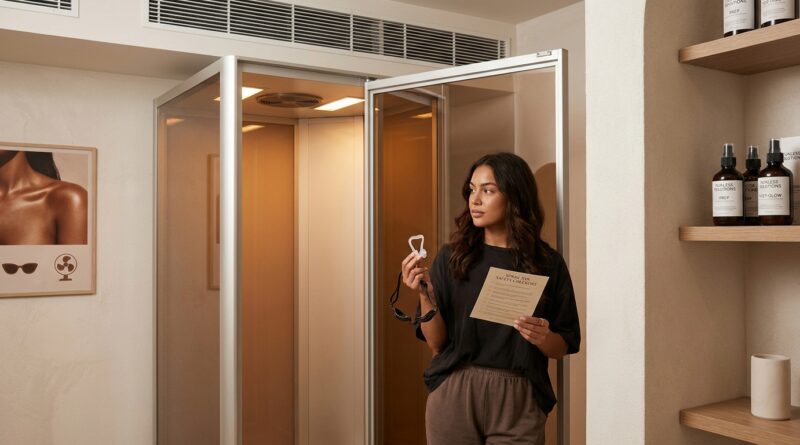
New ‘Spray-Tan Safe Breathing’ Rule: How To Protect Your Lungs When You Love Booth Tans
If you walk out of a spray tan booth with a scratchy throat, a weird cough, or that tight-chest feeling, you are not overreacting. A lot of people are told to worry about how DHA sits on the skin, but the bigger day-to-day issue can be the mist you breathe while standing in that little cloud. That matters even more if you tan often for weddings, trips, pageants, or content days. The truth is simple. We do not have great long-term data on repeated inhalation of spray tan mist, especially in automatic booths. So the smart move is not panic. It is reducing what you breathe in as much as you reasonably can. Think of it like hair spray or cleaning fumes. If something is floating in the air and making your throat burn, you want less of it in your lungs. The good news is you can still keep your glow and be a lot smarter about how you tan.
⚡ In a Hurry? Key Takeaways
- Spray tan inhalation safety comes down to reducing the amount of mist you breathe, especially in enclosed automatic booths.
- Ask about booth ventilation, use nose filters and eye protection, and time your breathing so you are not inhaling during each spray pass.
- If you have asthma, sensitive lungs, or repeat symptoms after booth tans, a manual technician-applied tan is usually the safer choice.
Why this is suddenly getting more attention
Spray tans are not new. What is changing is the amount of attention being paid to repeated inhalation exposure. DHA, the ingredient that reacts with the top layer of your skin to create that bronzed color, has mostly been discussed as a skin-contact issue. But in a booth, it is not just landing on your arms and legs. Some of it becomes airborne mist.
That is where people start asking better questions. What happens when you inhale small amounts over and over? What about people who tan weekly all summer? What about workers in salons? We still do not have perfect answers. And when the data is incomplete, the practical rule is pretty common-sense. Cut exposure where you can.
If you have also been wondering how much product on the skin is too much, our guide on New ‘DHA-Max Line’ Rule: How Much Self-Tanner Is Actually Safe To Slather On At Once? is a useful companion read. Skin amount and inhalation are different issues, but both matter.
What “spray tan inhalation safety” really means in real life
It does not mean you need to swear off every spray tan forever. It means making smart choices before, during, and after your session so you are not just standing there taking full breaths in a fog of cosmetic mist.
Automatic booth tans are usually the bigger concern
In an automatic booth, you stand in a set space while the machine sprays around you. That setup can create a denser aerosol cloud for a short period. Even with built-in ventilation, you are still inside the mist zone.
That is why “just hold your breath” is not very helpful advice. Most people cannot comfortably hold their breath through multiple passes, turns, and pauses. You need a better plan than that.
Manual tans can lower inhalation exposure
A technician-applied tan often gives you more control. A good tech can spray more precisely, avoid your face until you are ready, and use lighter passes. You can also speak up if you need breaks. That does not make manual tans risk-free, but for people with asthma, reactive airways, or booth-related coughing, it is often the better option.
How to vet a salon before you book
This part matters more than most people realize. A decent salon should be able to answer a few basic questions without acting annoyed.
Ask about ventilation
You do not need to sound like an engineer. Just ask:
- Does the booth have active ventilation or extraction during and after the spray?
- How often are filters changed?
- Does the room clear quickly between sessions?
- Do you offer nose filters, eye protection, or lip balm as barriers?
If the staff looks confused, shrugs, or says nobody has ever asked, that tells you something.
Use your senses when you walk in
If the room smells heavily of stale spray solution, feels stuffy, or has visible residue floating around after the last client, that is not ideal. A well-run salon should not feel like a trapped fog machine.
Look for cleaning and airflow habits
Doors left open between appointments, vents that are actually running, and quick wipe-downs of overspray residue are good signs. Thick residue buildup can be a clue that mist is settling everywhere instead of being cleared well.
What protective gear actually helps
This is where people tend to get either no guidance or silly guidance. Here is the simple version.
Nose filters
Disposable nose filters are one of the easiest ways to reduce inhalation through the nostrils. They are small foam or fiber inserts that sit just inside the nose. They are not glamorous. They are useful.
They help most in booth sessions because that is where you are surrounded by airborne mist. Make sure they fit snugly and are clean. If they keep falling out, they are not doing much.
Eye protection
Goggles or disposable sticky eye shields help keep mist out of your eyes and can also make it easier not to reflexively gasp or blink during the face pass. If your eyes burn after sessions, ask for proper protection every time.
Lip balm or petroleum barrier
This is more about reducing product contact on the lips than lung safety, but it still helps. Put a decent layer on before the session so you are less likely to get that dry, coated feeling in your mouth.
What about a mask?
A regular loose mask is not practical during a full-face spray tan because it will block the tan and leave lines. If lung protection is your top concern, that is usually your sign to skip the booth and choose a technician-applied tan where the face can be handled more carefully, or to use a self-tanner at home instead.
How to breathe during a booth tan without making yourself miserable
“Hold your breath” is lazy advice. A better approach is controlled breathing.
Try this timing method
- Take a normal breath just before the spray starts.
- Hold briefly during the main pass, especially when the nozzle is near your face and chest.
- Exhale slowly once the spray moves away.
- If the booth pauses between passes, use that moment for a calm breath.
The goal is not a heroic breath-holding contest. It is simply avoiding direct inhalation during the heaviest mist moments.
Keep your mouth closed when possible
If you can breathe through your nose with filters in place, that is usually better than accidentally gulping mist through your mouth. If your nose is blocked from allergies or congestion that day, think twice about a booth appointment.
Do not book when your lungs are already irritated
If you are getting over a cold, your asthma is flaring, your allergies are wild, or wildfire smoke has already been bothering you, that is probably not the day to stand in an aerosol booth.
Who should be extra careful
Some people have less margin for error.
You should think twice about booth tans if you have:
- Asthma
- Chronic bronchitis
- Vocal cord sensitivity
- Frequent cough after fragrances or aerosols
- Recent respiratory infection
- Pregnancy concerns that make you want to reduce unnecessary inhalation exposures
If that is you, a manual tan or at-home lotion, mousse, or drops may be the easier answer. Pretty does not need to come with a cough.
Signs your current setup is not working for you
Pay attention to patterns. If the same thing happens every time, your body is giving you information.
- Scratchy throat after most sessions
- Coughing during the drive home
- Chest tightness that was not there before
- Burning eyes or runny nose right after the booth
- Feeling like you need to clear your throat for hours
One mild episode may just be irritation. Repeat episodes are a sign to change something. Better ventilation, nose filters, a different salon, or switching from automatic booth to manual application can make a real difference.
When to skip the booth and choose another option
Sometimes the best safety trick is not a gadget. It is picking a different method.
Choose a manual technician-applied tan if:
- You cannot comfortably hold your breath during booth passes
- You keep having respiratory irritation after booth tans
- You want more control around the face
- You have asthma or sensitive lungs
Choose at-home self-tanner if:
- You want to avoid aerosol exposure altogether
- You only need color on a predictable schedule
- You are okay trading booth convenience for more control
For a lot of people, lotions and mousses are the simplest answer because they take inhalation out of the equation entirely.
At a Glance: Comparison
| Feature/Aspect | Details | Verdict |
|---|---|---|
| Automatic booth spray | Fast and convenient, but often puts you in a dense mist cloud for several spray passes | Good only if ventilation is strong and you use breathing precautions |
| Manual technician-applied tan | More control, more precise spraying, easier to protect face and pause between passes | Usually the better choice for sensitive lungs |
| Protective add-ons | Nose filters, eye protection, lip balm barrier, and smart breath timing all reduce exposure | Worth using, but not a substitute for good ventilation |
Conclusion
You do not need to panic about every spray tan, but you also do not need to accept “just hold your breath” as real safety advice. There is fresh attention in dermatology and cosmetic safety circles on how little data we have about repeated inhalation of DHA mists, especially in automatic booths where you stand in a dense aerosol cloud on a predictable schedule. That matters right now because summer and early fall are prime spray-tan months, and lots of people are booking weekly sessions with almost no guidance. The best move is a calm one. Ask about ventilation. Use nose filters and eye protection. Time your breaths during each spray pass. And if booth sessions keep leaving you coughing or tight-chested, switch to a manual tan or a non-aerosol option. You can absolutely keep your glow. The goal is just to stop treating your lungs like they are not part of the appointment.