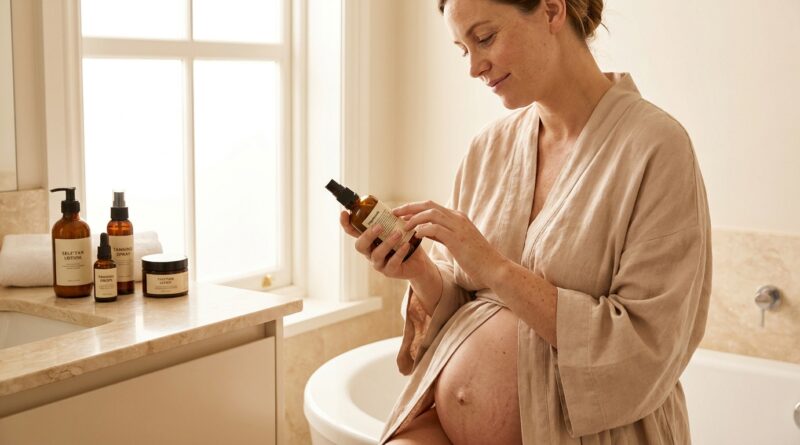
New ‘Pregnancy-Safe Tan’ Rule: How To Keep Your Glow While Every Label Suddenly Looks Scary
You finally find a self tanner you like, then you get pregnant or start breastfeeding and suddenly the bottle feels suspicious. That “clean,” “botanical,” and “non-toxic” language does not help when what you really want to know is simple. Can I use this without taking dumb risks? The good news is that newer 2026 medical guidance has made this a lot less murky. For most people, the big issue is not a basic self tanning lotion or mousse used on intact skin. It is inhaling spray tan mist, putting products on irritated or broken skin, or using formulas that make your newly sensitive skin angry. So the short version is reassuring. A pregnancy safe self tanner is usually a lotion, cream, gel, or mousse applied carefully at home, while spray booths and aerosol mists are the ones to treat much more cautiously.
⚡ In a Hurry? Key Takeaways
- Most experts consider a pregnancy safe self tanner to be a topical lotion, mousse, or cream used on healthy skin, because DHA absorption through skin appears low.
- Skip spray booths, aerosol sprays, and any tanning method you could inhale, especially during pregnancy.
- If you are breastfeeding, avoid applying self tanner where baby’s mouth or skin will have direct contact, especially the nipple and chest area right before feeds.
Why labels suddenly feel useless when you are pregnant
This is the part that drives people nuts. Beauty labels are built to sell comfort, not answer medical questions. “Natural” is not the same as tested in pregnancy. “Clean” is not the same as safe to inhale. And “doctor formulated” can still mean almost nothing if the company never explains how the product should be used during pregnancy or breastfeeding.
That is why the new guidance matters. It focuses less on marketing words and more on route of exposure. In plain English, your skin and your lungs are not the same thing. A product that is low concern on the surface of the skin can become a different safety question if you are breathing it in.
What the 2026 guidance actually says about DHA
The active ingredient in most self tanners is DHA, short for dihydroxyacetone. It reacts with the very top layer of dead skin cells to create that tanned look. The fresh medical guidance for 2026 keeps landing on the same practical point. When DHA is used on intact skin in a lotion or mousse, systemic absorption appears to be very low.
That does not mean “rub anything anywhere with zero thought.” It means the main concern is limited when the product stays where it is supposed to stay, on the outer skin, and when your skin barrier is not damaged.
Why this matters in pregnancy
Pregnancy makes people extra careful for good reason. But it also makes every half-risk sound huge online. The evidence so far does not show that standard topical self tanner use leads to major exposure when used properly. So if your goal is to avoid unnecessary panic, this is the most calming part of the story.
Why this matters in breastfeeding
Breastfeeding adds a separate issue. It is not just about what gets absorbed. It is also about what can transfer directly to baby through skin contact. So even if a self tanner is generally low concern, you still do not want it on the nipple, areola, or any area baby will lick, nuzzle, or rub against right after application.
The new rule set: what counts as a pregnancy safe self tanner
If you want one clear rule, use this. Pick a non-aerosol self tanner, apply it to healthy skin, let it dry fully, and avoid any chance of inhaling it or transferring it to baby.
Usually the better choice
Lotions, creams, gels, drops mixed into moisturizer, and mousses are generally the simpler option. They give you control. You can apply them with gloves or a mitt, wash your hands, and avoid sensitive areas.
Use extra caution or skip
Spray booths, aerosol cans, and face mists are the trouble spot. The issue is not that they instantly become toxic. The issue is that overspray can be inhaled or get into your mouth, nose, or eyes. That creates a different exposure pathway, and one that medical guidance still treats more cautiously.
Why spray booths are a different safety story
This is where a lot of confusion starts. People hear “self tanner is probably fine” and assume all self tanners are equal. They are not.
With a lotion, DHA mostly stays on the surface of the skin. With a spray booth, fine particles float in the air. Even with nose plugs, lip balm, and closed eyes, there is still a chance you inhale some mist. During pregnancy, most cautious guidance says that if you can avoid inhalation exposure, you should.
So if you are deciding between a home mousse and a salon spray booth, the mousse wins on safety practicality. Not because it is magically perfect, but because it is easier to control.
Your skin barrier changes in pregnancy, and that matters more than people realize
Pregnancy can make your skin drier, itchier, more reactive, and more prone to irritation. That means the safest product on paper can still be the wrong one for you if it causes a rash.
Skip self tanner on broken or freshly treated skin
Do not apply self tanner over cuts, eczema flares, sunburn, freshly shaved irritated skin, or right after strong exfoliating acids or retinoids. Irritated skin is not the moment to experiment.
Fragrance can be the real deal-breaker
A lot of people fixate on DHA and miss the obvious culprit. Fragrance, essential oils, and heavily perfumed formulas may be more likely to bother your skin during pregnancy than the tanning ingredient itself. If your nose is suddenly a bloodhound, this matters even more.
How to choose a safer product without reading a chemistry textbook
You do not need to become a cosmetic chemist. You just need a short checklist.
Look for these green flags
Choose a non-aerosol formula. Pick one with a short ingredient list if possible. Go for fragrance-free or lightly scented if your skin is touchy. Patch test first. And use it on body areas where you can easily control the application.
Watch for these yellow flags
Heavy fragrance. Essential oil overload. Tingling “instant bronzing” additives that irritate you. Products marketed as dry sprays, micro-mists, or salon booth alternatives. Those are not automatic no’s for everyone, but they are not the easiest answer in pregnancy either.
Also remember that once you have your tan, daily sun protection still matters. If you need help picking one that does not wreck your color, New ‘BEMT Glow-Safe’ Rule: How To Pick The New Sunscreens That Actually Protect Your Tan And Your Skin is a handy next read.
Practical rules for breastfeeding moms
Breastfeeding guidance is usually less about skin absorption and more about accidental contact.
Best practice
Apply after a feed, not right before one. Avoid the breast and nipple area. Let the product fully dry before holding baby skin-to-skin. Wash off any residue from areas baby may touch with their mouth.
What about gradual tanners?
These can be a nice middle ground because they are often easier to apply evenly and may use lower concentrations per use. The same rule still applies. Keep them off areas that baby will directly contact during feeding.
A simple routine if you still want a glow
If you want the least stressful plan, do this:
Step 1
Choose a lotion, cream, gel, or mousse. Not a booth. Not an aerosol.
Step 2
Patch test on a small spot for 24 hours, especially if pregnancy has turned your skin dramatic.
Step 3
Apply to clean, dry, intact skin with a mitt or gloves in a well-ventilated room.
Step 4
Avoid your nipples, chest area before nursing, mucous membranes, and any broken skin.
Step 5
Let it dry fully. Wash hands well. Put on loose clothing.
When to ask your OB, midwife, or dermatologist
Most people will not need a special appointment just to use self tanner. But do check with your clinician if you have severe eczema, a major skin condition, open skin, allergy history, or if you are considering professional spray tanning and want personalized advice.
It is also smart to ask if you are dealing with hyperpigmentation, melasma, or a recent reaction to skincare. Pregnancy skin can be unpredictable. There is no prize for pushing through a bad reaction.
At a Glance: Comparison
| Feature/Aspect | Details | Verdict |
|---|---|---|
| Topical lotion or mousse | DHA on intact skin appears to have low absorption based on current guidance. Easy to control application. | Usually the best pregnancy-safe option |
| Spray booth or aerosol mist | Main concern is inhalation of airborne particles, plus contact with eyes, nose, and mouth. | Best to avoid or be very cautious |
| Breastfeeding use | Generally lower concern on body skin, but avoid nipple and chest areas baby may contact during feeds. | Usually okay with smart placement and timing |
Conclusion
You do not need to choose between panic and pretending nothing matters. The newer 2026 guidance gives a much more grounded answer. A pregnancy safe self tanner is usually a controlled, non-aerosol topical product used on healthy skin, while spray booths and inhaled mist are the bigger concern. For breastfeeding, the extra rule is simple. Keep it away from areas your baby will touch with their mouth or face. That kind of clear, boring, practical advice is exactly what most moms-to-be need. Not fear. Not marketing fluff. Just a rule set that helps you keep your glow without taking unnecessary chances.