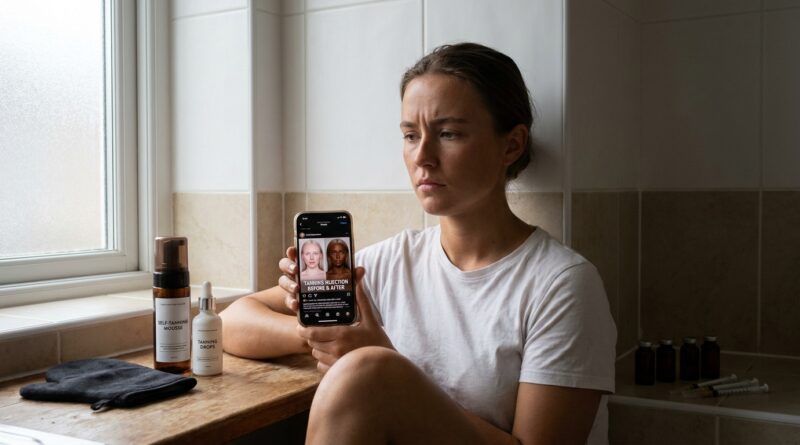
New ‘Peptide Tan’ Cancer Warning: The Truth About Melanotan, Injections And Why Sunless Glow Lovers Should Care
If you use self-tanner, tanning drops, or the occasional spray tan, the latest melanotan warnings can sound terrifying. That is completely understandable. The headlines often lump very different products together, and that leaves regular people wondering if their mousse bottle is suddenly a cancer risk too. Here is the simple version. Melanotan is not the same thing as the bronzing foam or salon spray tan you put on your skin. It is an unregulated peptide, often sold online or through social media, usually as an injection or nasal product, and doctors are warning about it because the safety risks are real and the ingredients may not even be what the label claims. If you care about melanotan tanning peptide safety, the key thing to know is this. Cosmetic self-tanners stain the outer layer of skin. Melanotan tries to change pigment inside the body. Those are very different categories, with very different levels of risk.
⚡ In a Hurry? Key Takeaways
- Melanotan injections and nasal products are not the same as self-tanner, tanning drops for lotion, or spray tans. They carry very different risks.
- If a tanning product claims to work “from the inside,” especially by injection, peptide, or nasal spray, stop and check with a dermatologist before using it.
- If you have already tried melanotan, do not panic. Book a skin check, mention exactly what you used, and watch for changing moles or new side effects.
What happened, and why dermatologists are worried
The fresh warnings are about underground tanning peptides, especially products sold as melanotan or melanotan II. These are often marketed online as a shortcut to a darker tan without much sun exposure. That pitch is powerful. It also skips over a lot.
Doctors are worried for a few reasons. First, these products are generally not approved as safe cosmetic tanning tools. Second, they are often bought from sellers that do not operate like normal pharmacies. That means the dose, purity, and even the true contents can be uncertain. Third, dermatologists have long raised concerns that these products may trigger side effects and complicate skin cancer monitoring, especially when users notice changes in moles or rapid darkening of pigment.
That does not mean every person who used one will get cancer. It does mean this is not a casual beauty hack. It is a medical risk question.
The big thing people are getting wrong
Many readers are seeing “tan product” in a headline and assuming their regular self-tanning routine is part of the warning. In most cases, it is not.
What self-tanner actually does
Standard self-tanners, including lotions, mousses, waters, and many spray tans, usually use DHA, short for dihydroxyacetone. That ingredient reacts with dead cells on the outermost layer of your skin. It creates a temporary bronzed look. It does not increase your melanin. It does not need a needle. It does not work by changing your body from the inside.
What melanotan products claim to do
Melanotan products are sold as peptides that stimulate melanin production in the body. That is a much bigger biological step than putting color on the skin surface. It is why the conversation around melanotan tanning peptide safety is so serious. You are no longer talking about makeup-adjacent cosmetics. You are talking about an unregulated substance with body-wide effects.
Why “it’s just a peptide” is not a reassuring phrase
On TikTok and in biohacking circles, the word “peptide” can sound clean, modern, and science-y. But a peptide is not automatically safe. Plenty of substances can affect the body in strong ways. The real questions are simple.
- Is it approved for this use?
- Was it made under proper quality controls?
- Has it been tested for safety and dose consistency?
- Do we know the short-term and long-term risks?
With underground tanning peptides, the answer to those questions is often shaky at best.
Common side effects and red flags people report
Reports around melanotan products have included nausea, flushing, appetite changes, darkening of moles, and other pigment changes. Some users also combine them with intentional UV exposure to “boost results,” which adds another layer of skin cancer risk because now you have both the unregulated product and more UV damage in the mix.
The mole issue is one reason dermatologists get especially nervous. If a product causes existing moles to darken or new spots to become more noticeable, that can muddy the picture when doctors are trying to spot signs of melanoma early.
So are foam, drops, and spray tans safe?
For most healthy adults, typical cosmetic self-tanners are in a very different risk bucket from injectable or nasal melanotan products. That does not mean every cosmetic product is perfect. It means the mechanism is different and the concern in these cancer-warning headlines is not mainly about your supermarket self-tanning mousse.
Self-tanning foam and lotion
These sit on the skin and create temporary color. Follow label directions, patch-test if you have sensitive skin, and avoid broken or irritated skin.
Tanning drops
If they are drops designed to mix into moisturizer and apply on top of the skin, they are basically another form of self-tanner. If someone online is calling something “tanning drops” but it is swallowed, inhaled, or marketed as a peptide, that is a whole different story. Read the label carefully.
Spray tans
Salon spray tans and home spray tans are also usually surface-level cosmetic bronzers. The usual caution is avoiding inhalation during application and protecting eyes and lips, not peptide-related cancer questions.
How to sanity-check a “biohack tan” trend in 60 seconds
If you see a new tanning craze on social media, use this quick filter before you buy anything.
1. Ask how it works
If it works by coating the skin, that is generally a cosmetic. If it claims to alter pigment from inside the body, raise your guard.
2. Look for the delivery method
Injection, nasal spray, capsule, or “research peptide” language should make you stop immediately.
3. Watch for sketchy wording
Be careful with phrases like “not for human consumption,” “lab use only,” “secret clinic formula,” or “DM to order.” None of that belongs in a normal beauty purchase.
4. Check whether the seller is acting like a real medical provider
A real clinician takes a history, explains risks, reviews your skin and health background, and does not sell a magic tan as a casual beauty extra through a social post.
5. Notice if sun exposure is still part of the pitch
If the instructions still involve tanning in the sun or using tanning beds, that is another red flag. A “safer tan” that still pushes UV exposure is not solving the core problem.
If you already tried melanotan, here is what to do next
Do not panic. Also, do not hide it from your doctor out of embarrassment. Dermatologists have heard much stranger stories, and their job is to help, not shame you.
Book a skin check
Tell the dermatologist exactly what you used, how you took it, how long you used it, and whether you also spent more time in the sun or tanning beds.
Take photos of changing spots
If you noticed a mole or freckle getting darker, larger, or oddly shaped, take clear photos with dates. That gives your doctor helpful context.
Write down side effects
Nausea, flushing, unusual fatigue, appetite changes, headaches, or anything else worth noting should go on the list.
Bring the packaging if you still have it
Even if the label looks vague or amateur, it may help your clinician understand what was sold to you.
What a dermatologist will likely care about most
Your doctor is usually going to focus on a few practical things. Have any moles changed? Did you increase UV exposure? Are there side effects beyond tanning? Do you have a personal or family history of melanoma or atypical moles? This is why honesty matters. The more specific you are, the more useful the visit will be.
The safest path to a glow right now
If your goal is simply to look a little more bronzed, you do not need to gamble on underground peptides. The safer route is boring, but in a good way.
- Use a standard self-tanner from a mainstream brand.
- Get a professional spray tan if you want even color for an event.
- Wear sunscreen every day, even if you self-tan.
- Skip tanning beds.
- See a dermatologist for any mole that changes.
That approach may not sound flashy enough for social media, but it is a lot better for your skin and your peace of mind.
At a Glance: Comparison
| Feature/Aspect | Details | Verdict |
|---|---|---|
| Regular self-tanner | Usually uses DHA to darken the outer layer of dead skin cells temporarily. Applied on top of skin. | Generally separate from the melanotan warning. Follow label directions and basic skin-safety steps. |
| Melanotan injections or nasal products | Unregulated peptide products marketed to increase pigment from inside the body. Purity and dose may be uncertain. | High caution. This is the main concern in current dermatologist cancer-risk warnings. |
| TikTok “biohack tan” trends | Often use vague science language, seller DMs, or “research use only” products with little trustworthy oversight. | Treat as a red flag until a licensed dermatologist or physician says otherwise. |
Conclusion
The most useful takeaway here is not “be scared of all tanning products.” It is “know what category you are dealing with.” That is what helps cut through the panic. These warnings are about unregulated tanning peptides like melanotan, not about every bottle of self-tanner in your bathroom. If you stick with normal cosmetic sunless tanners, wear sunscreen, and treat any inside-the-body tanning claim with real suspicion, you are already making the smarter choice. And if you already experimented, you have not ruined your chance to protect yourself. A straightforward talk with a dermatologist, plus regular skin checks, can go a long way. That is the goal today. Clear up the confusion, lower the panic, and help you keep your glow without taking risks you did not sign up for.