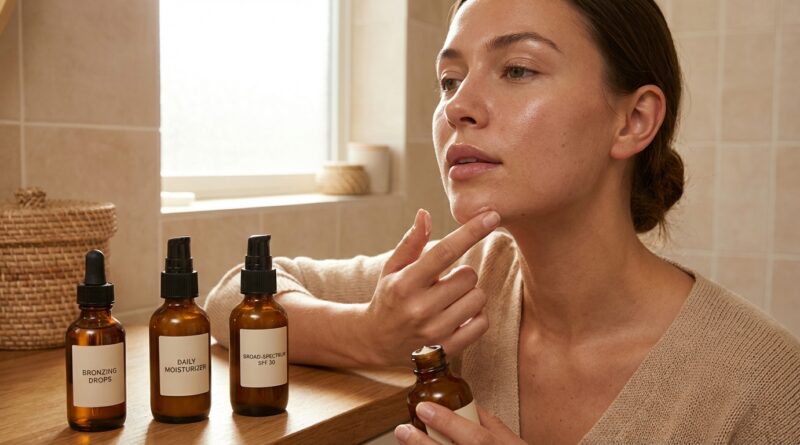
New ‘Barrier-First Glow’ Rule: How To Stop Viral Bronzing Drops From Quietly Wrecking Your Skin
Your skin can look glowy and still be unhappy. That is the problem with the bronzing-drop boom right now. People are mixing tanning or bronzing drops into moisturiser, loving the quick warmth, then wondering why their face suddenly feels tight, stingy, itchy, flaky, or weirdly breakout-prone. If that sounds familiar, you are not being dramatic. A lot of these formulas are fine for some people, but they are not automatically gentle just because you mixed them with cream.
So, are tanning drops safe for sensitive skin? Sometimes, yes. Always, no. The safer way to use them is to put your skin barrier first. That means choosing simpler formulas, patch testing, avoiding over-exfoliating, and never using glow as a reason to skip sunscreen. Think of this as the new barrier-first glow rule. If your skin is already irritated, dehydrated, or eczema-prone, your first job is not getting darker. It is keeping your face calm.
⚡ In a Hurry? Key Takeaways
- Tanning drops are not automatically safe for sensitive skin. They are safest on a healthy, calm skin barrier.
- Start with fewer drops, patch test first, and do not mix them into a routine packed with acids, retinoids, or scrubs.
- If your skin burns, stings, flakes, or breaks out more, stop and repair your barrier before trying again.
Why bronzing and tanning drops can upset sensitive skin
There are two different products getting lumped together online. Instant bronzing drops usually tint the skin right away and wash off. Self-tanning drops usually use DHA, the ingredient that reacts with dead skin cells to create a temporary tan.
Both can be irritating in the wrong routine.
The biggest issue is not just the drops themselves. It is everything happening around them. People often add these products on top of exfoliating acids, retinoids, acne treatments, fragranced serums, and harsh cleansers. That is when a nice glow routine turns into a red, stingy mess.
What “barrier-first” really means
Your skin barrier is the outer layer that helps keep water in and irritants out. When it is struggling, your face may feel dry but oily at the same time. Products burn. Red patches show up. Breakouts can look worse. Even a formula that used to feel fine can suddenly feel aggressive.
If your barrier is damaged, tanning drops are more likely to sting or trigger irritation. So the new rule is simple. Do not ask, “Will this make me glow?” first. Ask, “Is my skin calm enough to handle this?”
So, are tanning drops safe for sensitive skin?
The honest answer is: they can be, but only under the right conditions.
They are more likely to be okay if:
Your skin is currently calm, you are not dealing with an eczema flare, your routine is simple, and you patch test before putting the product all over your face.
They are less likely to be okay if:
Your skin already burns when you apply products, you are peeling from acids or retinoids, you have active dermatitis, or you keep chasing a deeper glow by using too many drops too often.
Sensitive skin is not one thing. Some people react to fragrance. Others react to preservatives, essential oils, or strong actives nearby in the routine. That is why one person can love a viral tanning drop and another gets an itchy rash by day two.
The ingredients and habits that cause trouble
You do not need to read an ingredient list like a chemist. Just watch for a few common trouble spots.
1. Too many drops
More is not better. A deeper tan often means more chance of irritation, patchiness, and that dry, tight feeling afterward.
2. Mixing with active-heavy skincare
If your moisturiser already contains acids, vitamin C that stings, benzoyl peroxide, or retinoids, adding tanning drops can push sensitive skin over the edge.
3. Fragrance and essential oils
Some skin handles them fine. Sensitive skin often does not. If your face is reactive, simple is usually better.
4. Applying on a compromised barrier
If your face is already red, flaky, or burning after cleansing, that is not the night to experiment.
5. Forgetting sunscreen
This one matters. A self-tan or bronzed tint does not protect your skin. Looking more even-toned can trick people into thinking they need less SPF. They do not.
The barrier-first glow routine that actually makes sense
If you still want to use facial tanning drops, keep the routine boring. That is usually what sensitive skin likes.
Step 1: Check your skin before you start
Do a quick scan. Is your face stinging after washing? Is it flaky around the nose or mouth? Are you in the middle of an eczema or acne flare? If yes, pause the glow plan.
Step 2: Patch test like an adult, not like the internet
Try the mixed product on a small area near the jaw or side of the face for at least 24 hours. If you are very reactive, give it 48 hours. Watch for burning, itching, bumps, or a rash.
Step 3: Use a plain moisturiser
Mix the drops into a basic, fragrance-free moisturiser if possible. Skip the one packed with exfoliants or anti-aging actives for that night.
Step 4: Start low
Use fewer drops than the brand’s maximum suggestion. You can always build up next time. It is much harder to undo irritation.
Step 5: Keep the rest of the routine quiet
On tanning-drop nights, skip scrubs, acids, retinoids, strong masks, and anything that already tingles.
Step 6: Moisturise again if needed
If your skin tends to run dry, a simple moisturiser on top later can help reduce that tight feeling.
Step 7: Wear SPF the next day
Always. The glow is cosmetic. The sun damage is real.
What to do if your skin already feels irritated
If your face feels hot, itchy, stingy, or suddenly rough after using tanning drops, stop for a few days. Go back to basics.
Use a gentle cleanser. Use a bland moisturiser. Use sunscreen. That is it.
Do not try to “fix” the reaction with exfoliation. Do not pile on actives because you think the tan looks uneven. And do not keep applying more drops to even things out. That often makes things worse.
When to get medical help
If you have swelling, hives, severe burning, cracked skin, weeping patches, or an eczema flare that is spiralling, talk to a pharmacist, GP, or dermatologist. That is beyond a simple “my skin is a bit sensitive” moment.
If you are also acne-prone, be extra picky
Sensitive skin and breakout-prone skin often overlap, which makes this trend annoying. Some people do not just get redness. They get clogged pores, little bumps, or full breakouts after face self-tanner.
If that is you, this guide on New ‘Acne‑Safe Glow’ Rule: How To Choose Sunless Tanners That Won’t Wreck Breakout‑Prone Skin is worth reading next. It helps you sort out whether the problem is irritation, congestion, or both.
Signs your skin barrier wants a break from tanning drops
Watch for these clues:
- Your moisturiser suddenly stings
- Your skin feels shiny but dehydrated
- You see more redness around the nose, cheeks, or mouth
- Flakes show up even though you are moisturising
- You get random itchy bumps or rashy patches
- Your usual products no longer feel comfortable
If two or three of these are happening, stop the drops for a bit. A pause now is better than weeks of repairing your face later.
Who should be most cautious
Be extra careful with facial tanning drops if you have rosacea, eczema, very dry skin, a damaged barrier, recent overuse of retinoids or acids, or a history of reacting to fragranced skincare.
That does not mean you can never use them. It means your margin for error is smaller.
At a Glance: Comparison
| Feature/Aspect | Details | Verdict |
|---|---|---|
| Using tanning drops on calm skin | Works best when mixed with a plain moisturiser, started slowly, and patch tested first | Usually reasonable |
| Using tanning drops with acids or retinoids | Raises the chance of stinging, dryness, patchiness, and barrier irritation | Not a good idea |
| Skipping SPF because your face looks bronzed | A cosmetic glow does not give UV protection, even if your skin tone looks more even | Always avoid |
Conclusion
Bronzing and self-tanning drops can be a nice shortcut to a sunless glow, but they are not a free pass for sensitive skin. The smartest move is the barrier-first one. Keep your routine simple, patch test, start with less, and back off fast if your face starts sending warning signs. That way you can enjoy the glow trend without ending up with burning, breakouts, rashes, or a week of trying to calm your skin down. And no matter how healthy that tint looks in the mirror, keep wearing sunscreen. The best glow is the one that does not cost you your skin barrier.