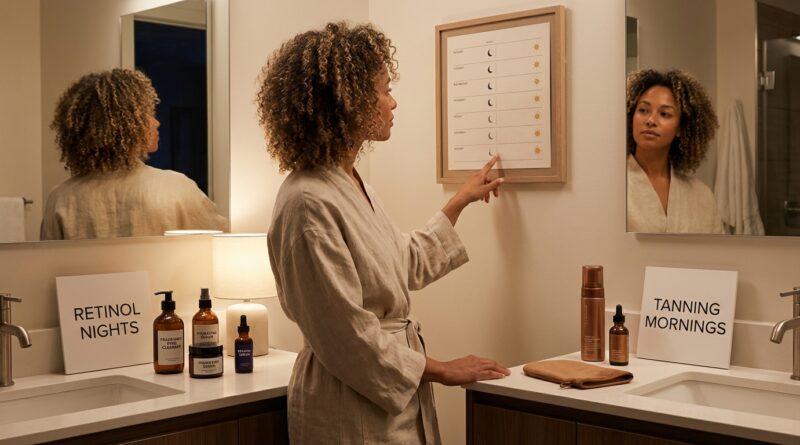
Can You Use Retinol And Self-Tanner Together? The New Patchy-Skin Problem No One Is Explaining Clearly
You are not imagining it. Retinol and self-tanner can absolutely make your skin act weird when you use them too close together. That “why is my tan disappearing from my chin but clinging to my forehead?” problem is real. So is the stinging, the sudden dry patches, and the blotchy color that shows up after what seemed like a normal skincare night. The confusing part is that most bottles never explain how these products can clash. Retinol speeds up skin cell turnover. Self-tanner needs a calm, even surface layer of skin to develop smoothly. Put those two facts together, and you get patchy color, uneven fade, or irritated skin that makes everything look worse. The good news is that retinol and self tanner safe to use together can be true, but only if you space them out, skip other harsh actives around tanning days, and pay close attention to your skin barrier.
⚡ In a Hurry? Key Takeaways
- Yes, retinol and self-tanner can be used together, but not at the same time and not on irritated skin.
- Pause retinol 1 to 2 nights before and after self-tanning your face for smoother, longer-lasting color.
- If your skin stings, flakes, or looks shiny and tight, fix the barrier first before adding tan back in.
Why retinol and self-tanner fight each other
Retinol is great for acne, texture, and fine lines. But it also makes skin turn over faster. That means old surface skin sheds more quickly.
Self-tanner works by reacting with the top layer of dead skin cells. That is where the color forms. If retinol is making that layer shed unevenly, your tan can grab in some spots and disappear in others.
This is why people often notice:
- Patchy cheeks
- Darker pores or hairline buildup
- Tan fading fast around the mouth and nose
- Stinging when tanning drops are applied
- Random dry islands of color
It is not always the tanner’s fault. Sometimes the skin underneath is just too stressed.
So, are retinol and self tanner safe to use together?
Yes, for most people, if your skin is healthy and you do not stack everything on the same day.
The safer answer is this. Use retinol on its own schedule. Use self-tanner on a separate schedule. Do not apply self-tanner right after a retinol night if your skin is even a little irritated.
If you are new to retinol, be even more careful. The first few weeks are when peeling, dryness, and sensitivity are most common. That is the worst time to test a fresh face tan.
The main mistake people make
They think of self-tanner as makeup or a harmless glow product. But facial self-tanners, tanning drops, and spray tans still depend on your skin surface behaving normally.
If you are also using:
- Retinol
- AHAs like glycolic or lactic acid
- BHAs like salicylic acid
- Benzoyl peroxide
- Scrubs or cleansing brushes
you can easily tip into over-exfoliation without realizing it. Then the tan goes patchy, and your skin starts to burn when simple products touch it.
A simple schedule that actually works
If you use retinol regularly and want to self-tan your face
Here is the easiest plan for most people.
- Night 1: Use retinol as usual.
- Night 2: Skip retinol. Use only gentle cleanser, moisturizer.
- Day 3 or Night 3: Apply self-tanner to clean, dry, moisturized skin if needed on dry areas only.
- Night 3: No retinol. Let the tan develop.
- Night 4: Still keep it gentle if your skin feels dry.
- Night 5: Resume retinol if skin feels normal.
That pause gives your skin a more even surface and helps the tan last longer.
If you are brand new to retinol
Do not chase a perfect glow while your skin is still adjusting. Get stable first.
Use retinol just 1 to 2 nights a week at first. Keep self-tanner on separate days. If you notice tingling, peeling, or shiny tight skin, stop tanning your face until things calm down.
How to prep skin before self-tanner if you use retinol
Think “calm and even,” not “scrubbed within an inch of its life.”
Best prep steps:
- Use a gentle cleanser
- Skip retinol the night before
- Skip strong acids for at least 24 to 48 hours
- Moisturize dry zones like around the nose, mouth, and eyebrows
- Apply tanner lightly and blend well at the hairline and jaw
What not to do:
- Do not exfoliate aggressively right before tanning
- Do not apply tanner over peeling skin
- Do not mix tanning drops into a strong retinol cream
- Do not ignore stinging, because that is your skin asking for a break
Why your tan “slides off” faster when you use retinol
This part is simple. Retinol speeds up the shedding of the very skin cells that are holding onto the self-tanner color.
So even if your tan looks fine on day one, it may fade faster and less evenly than expected. Around the nose, chin, and mouth, where many people already get dryness or use more active products, the color can break apart first.
That is why spacing matters more than brand names. An expensive tanner cannot outsmart irritated, over-exfoliated skin.
What to do if you already have patchy, irritated skin
Stop the cycle first. Do not keep layering more tan on top to “fix” the blotches.
Try this reset
- Pause retinol for a few nights
- Pause acids and scrubs
- Use gentle cleanser only
- Use a plain moisturizer, ideally with ceramides or glycerin
- Wear sunscreen during the day
Once the stinging and flaking stop, then you can decide whether to reintroduce retinol or self-tanner first. Do not bring both back on the same day.
Face tanning drops vs mousse vs spray tan
They can all clash with retinol. But some are easier to control than others.
Tanning drops
Good for customizing color. Easy to overdo if mixed into a product that already contains active ingredients.
Foams or mousses
Can give stronger color, but they cling fast to dry patches. If retinol has left flaky areas, mousse will usually show them.
Spray tans
Convenient, but your face still has the same issue. If your skincare has weakened the barrier, the spray may develop unevenly or irritate you.
When you should not combine them at all
Take a full pause on face tanning if:
- Your skin burns when moisturizer goes on
- You have visible peeling
- Your barrier feels raw, tight, or itchy
- You recently increased your retinol strength
- You are using prescription tretinoin and still adjusting
In those cases, “safe to use together” becomes “not right now.”
A good rule for warmer months
As the weather gets warmer, people often add more actives, more shaving, more exfoliation, and more self-tanner all at once. That is a lot for facial skin.
Try this simple rule. Only one “stressful” skin step at a time. If tonight is retinol night, let that be enough. If tomorrow is self-tan day, keep the rest of the routine boring.
At a Glance: Comparison
| Feature/Aspect | Details | Verdict |
|---|---|---|
| Using both in the same routine | Retinol can irritate skin and create uneven surface texture, which makes tanner develop patchily. | Not recommended |
| Spacing them out | Pausing retinol 1 to 2 nights before and after tanning usually gives more even color and less irritation. | Best option for most people |
| Using on sensitive or peeling skin | Compromised skin barrier raises the risk of stinging, blotchiness, and fast fading. | Wait until skin calms down |
Conclusion
If you have been wondering whether retinol and self tanner safe to use together is actually possible, the answer is yes, but only with some breathing room between them. The recent spike in people layering active skincare with tanning drops, foams, and spray tans is causing a lot of avoidable burning, over-exfoliation, and patchy color. A simple schedule fixes most of it. Keep retinol and self-tanner on separate days, skip extra exfoliants around tanning time, and protect your skin barrier like it matters, because it does. Do that, and you get fewer surprise reactions, a more even glow, color that lasts longer, and healthier skin heading into the warmer months.