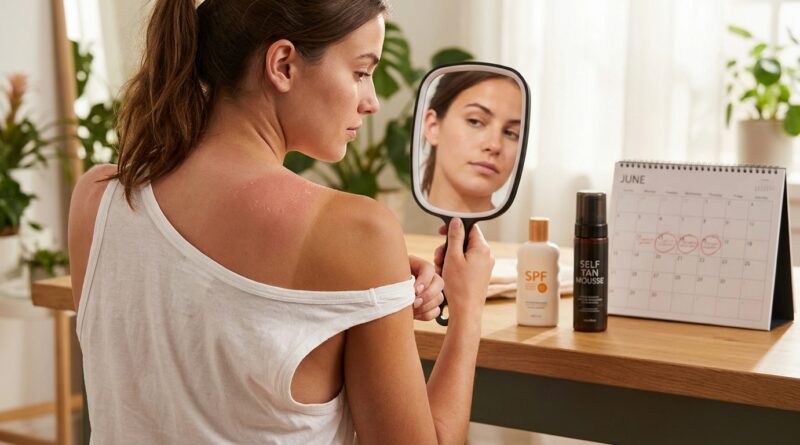
Can You Spray Tan Over Sunburn or Peeling Skin? The Safety Rules No One Explains Clearly
You are not overthinking this. Getting burned, watching your skin peel, then trying to figure out when it is safe to spray tan can feel weirdly confusing. One salon says wait a couple of days. Another says once the redness fades. Then someone online says self tanner is “safer anyway,” so it must be fine. Not exactly. The real issue is not just color. It is your skin barrier. If your skin is still inflamed, tender, peeling, blistered, or fresh from a peel or laser, adding DHA or getting sprayed can sting, develop unevenly, and sometimes leave you with patchy dark spots that hang around longer than the burn did. The simple rule of thumb is this: wait until the skin is fully healed. No heat, no pain, no peeling, no raw spots. For many mild sunburns that means at least 7 to 14 days. For worse burns or recent treatments, it can be longer.
⚡ In a Hurry? Key Takeaways
- Wait to spray tan until the sunburn or peeling skin is fully healed. For a mild burn, that is usually 7 to 14 days. If you still have redness, soreness, peeling, or blisters, it is too soon.
- Do a simple check before tanning: your skin should feel normal, look calm, and handle moisturizer without stinging.
- Spray tan over damaged skin can turn patchy and may raise the risk of irritation and post-inflammatory hyperpigmentation, especially after lasers, peels, or strong exfoliation.
How long to wait to spray tan after sunburn
If you want the clearest answer possible, here it is.
Do not spray tan over active sunburn or peeling skin. Wait until the area is fully healed.
For most mild sunburns, that means at least 7 to 14 days. For moderate or severe burns, sun poisoning, blistering, or burns that leave lingering redness, you may need 2 to 4 weeks or longer. If you had a chemical peel, laser, microneedling, or another energy-based treatment, follow your provider’s aftercare first. In many cases, the wait is also 1 to 4 weeks, depending on the treatment depth and how your skin is recovering.
The big idea is simple. Do not use the calendar alone. Use the condition of your skin.
Why spray tan on healing skin can go wrong
A spray tan does not damage skin the way UV tanning does. That part is true. But “safer than sun” does not mean “safe on injured skin right now.”
Spray tans and self tanners usually use DHA, which reacts with the dead skin cells on the surface. If your skin is peeling off unevenly, the tan grabs unevenly too. That is why recent burns often turn into leopard spots, streaks, or dark flakes around the peeling edges.
There is also the comfort issue. Healing skin is more sensitive. Fragrance, bronzers, prep sprays, barrier creams, and even plain DHA can sting irritated areas. And if the skin is still inflamed, you have a higher chance of lingering dark marks afterward. That is called post-inflammatory hyperpigmentation.
If you want the safer route once your skin has recovered, this guide on How to Get a Safe, Sunless Glow in 2026: The Best Way to Use DHA Self-Tanners Without Hurting Your Skin does a good job of breaking down how DHA works without the usual mixed messages.
The skin check that matters more than the date
Here is the practical test I wish more people were given.
It is too soon if you have any of these
Redness that is still bright or widespread.
Warmth or heat coming off the skin.
Tenderness, stinging, itching, or tightness.
Peeling, flaking, cracking, or rough patches.
Blisters or spots that look shiny, raw, or newly healed.
A moisturizer that still burns when you apply it.
It is more likely safe if all of these are true
Your skin tone has returned close to normal.
The area is no longer sore or hot.
There is no peeling at all.
The surface feels smooth and intact.
You can wash and moisturize the area with no sting.
What about self tanner instead of a spray tan?
Same rule. Different bottle.
If your skin is burned or peeling, self tanner is not the workaround people hope it is. It can still go patchy, cling to damaged spots, and irritate fresh skin. In some cases it looks worse because you see every dry edge up close while applying.
If your main goal is to hide redness fast, a body tint or cosmetic bronzing lotion is usually the better short-term option. It washes off. It does not rely on a chemical reaction with unstable surface skin. And if it looks bad, you are not stuck with it for a week.
How long to wait in specific situations
Mild pink sunburn with no peeling
Usually wait about 7 days, sometimes up to 10, and only if the skin feels fully normal by then.
Sunburn with peeling
Wait until the peeling is completely over, then give it 2 to 3 extra days if the skin still seems dry or uneven. For many people that means 10 to 14 days total.
Moderate burn with swelling or significant tenderness
Think 2 to 3 weeks, sometimes longer.
Blistering sunburn or sun poisoning symptoms
Wait at least several weeks. If you had fever, chills, nausea, dizziness, severe pain, or large blisters, treat this like a real medical issue first. Ask a clinician before doing any sunless tanning.
After a chemical peel, laser, or resurfacing treatment
Do not guess. Ask your provider. Some light treatments may allow tanning after about 1 to 2 weeks. Deeper peels or more aggressive lasers can mean 3 to 4 weeks or more. Photosensitive skin needs extra caution.
If you absolutely have an event coming up
I get it. Wedding. Vacation redo. Big night out. You want to look less blotchy now.
Your safest options are:
Use a wash-off body makeup or cosmetic bronzer.
Moisturize well for a few days first, so dry areas look less obvious.
Skip exfoliating a healing burn. That will not “speed it up” in a helpful way.
Wear loose clothing so irritated skin is not rubbed raw.
And if the burn is still visible, focus on recovery, not color correction. Your future skin will thank you.
How to prep once your skin really is healed
Once the burn is fully gone, prep matters a lot. Recently healed skin can still be a little uneven, even when it looks fine in normal light.
Do this first
Moisturize daily for several days before your tan.
Use a gentle wash, not a scrubby one.
If you exfoliate, keep it light and stop if the skin looks pink after.
Patch test a small area if your skin has been reactive.
Skip this
Harsh scrubs.
Acid peels at home right before tanning.
Retinoids on the area the night before if they still make you sensitive.
Shaving over skin that is still flaky or irritated.
When to see a doctor instead of a tanning tech
A salon can tell you whether a tan may go on evenly. They cannot diagnose skin damage.
See a medical professional if you have:
Blistering over a large area.
Fever, chills, nausea, vomiting, or dizziness after sun exposure.
Burns that are getting more painful instead of less.
Signs of infection, like pus, increasing redness, or warmth.
Dark marks that keep worsening after the burn heals.
The bottom line rule
If you are still asking whether your sunburn is healed enough to spray tan over, it probably is not.
Healthy skin gives you the better tan anyway. Less patchiness. Less sting. Less risk of those annoying brown marks that can outstay the burn itself.
At a Glance: Comparison
| Feature/Aspect | Details | Verdict |
|---|---|---|
| Active sunburn | Skin is red, hot, sore, tight, or swollen. DHA may sting and develop unevenly. | Wait. Do not spray tan yet. |
| Peeling or flaky healing skin | Tan clings to loose skin and dry edges, causing patchiness and possible dark marks. | Wait until peeling is fully finished, then reassess. |
| Fully healed skin | No redness, no heat, no tenderness, no peeling, and moisturizer does not sting. | Usually okay to spray tan with gentle prep. |
Conclusion
The safest answer is not the fastest one, but it is the one that protects your skin long term. If you got burned on vacation, it is tempting to rush into a spray tan to even everything out. That is exactly where people get into trouble. Spray tanning over recently damaged, peeling, or treatment-sensitized skin can lead to more irritation, blotchy color, and stubborn pigment changes. A good rule of thumb is simple: wait until the skin is fully healed, then wait a little longer if you are unsure. For a mild sunburn, that is often 7 to 14 days. For peeling, blistering, sun poisoning, or recent lasers and peels, it may be several weeks. Bronze smart, not fast. Your color will look better, and more importantly, your skin barrier gets the respect it deserves.